
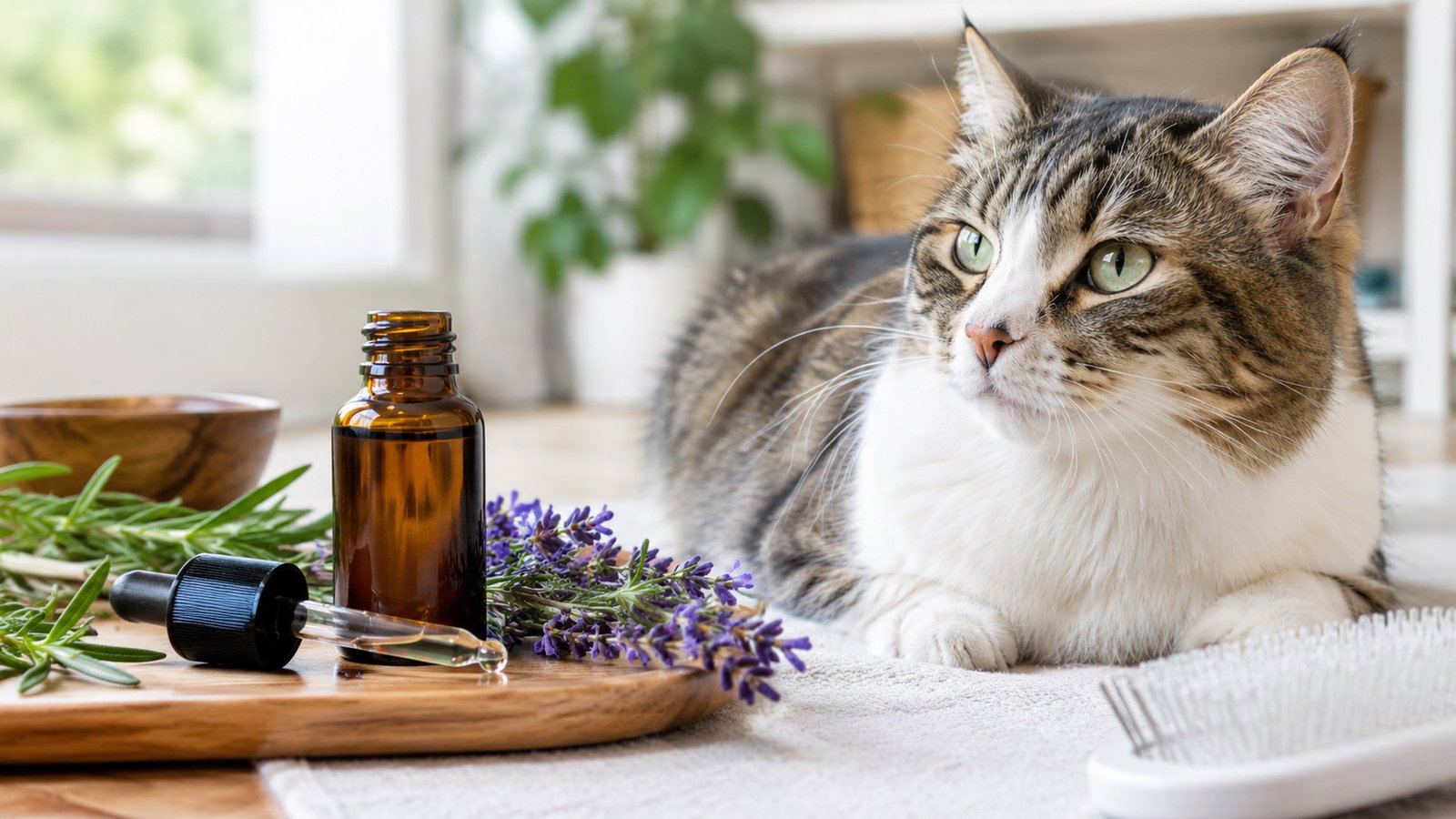
Fleas can turn a comfortable home into an itchy nightmare, which is why many cat owners search for essential oils to kill fleas on cats as a natural alternative to conventional treatments. The problem is that an ingredient capable of repelling or killing an insect is not automatically safe for a cat.
This guide explains what you should know before using essential oils around a flea-infested cat. You’ll learn which oils are commonly promoted for flea control, why cats are particularly sensitive to concentrated plant oils, what the available evidence actually tells us, and which popular DIY approaches are best avoided.
In This Article
Essential Oils to Kill Fleas on Cats: Can They Actually Work?
Essential oils are highly concentrated extracts from plants. Some contain compounds that can affect insects, including compounds with insecticidal or repellent properties. That fact has made oils such as lavender, peppermint, eucalyptus, cedarwood, and lemongrass popular in homemade flea remedies.
There is an important distinction, though: something that kills or repels fleas in a laboratory setting is not necessarily an appropriate treatment for a cat.
A flea-control ingredient has to pass two very different tests:
- Does it affect fleas?
- Can it be used safely on or around cats at an effective concentration?
Those questions should never be treated as interchangeable.
Killing fleas is not the same as controlling an infestation
Fleas have a complicated life cycle. Adult fleas live primarily on animals, while eggs, larvae, and pupae can be found in the surrounding environment.
That means even a treatment that successfully kills adult fleas on your cat may not eliminate the problem. New adults can continue emerging from the environment and jumping back onto your pet.
This is one reason flea infestations can seem to “come back” even after owners have removed visible fleas.
Effective flea control usually requires a combination of treating the cat appropriately and addressing flea stages in the home.
What about natural flea remedies?
The appeal of essential oils is understandable. Cat owners often want to reduce their use of harsh chemicals, avoid unnecessary ingredients, or find something they already have at home.
Natural products can still cause significant problems, however. Essential oils are concentrated substances, and cats can be exposed when an oil is applied to their fur and subsequently swallowed during grooming.
A cat may also encounter oils through contaminated bedding, surfaces, sprays, or diffusers.
Natural does not mean harmless, and “diluted” does not automatically mean safe.
Why a flea-repellent oil may not be enough
Even if a particular essential oil discourages fleas from staying on an animal, it may provide only temporary relief rather than reliable control.
A successful flea-control strategy needs to consider:
- Adult fleas currently on the cat
- Flea eggs and larvae in the environment
- Reinfestation from the household
- The duration of protection
- The cat’s age and weight
- Potential toxicity
- Whether the treatment has been specifically evaluated for feline use
For that reason, simply choosing the strongest-smelling essential oil isn’t a sensible flea-control strategy.
Why Cats Are Especially Sensitive to Essential Oils
Cats are not simply small dogs when it comes to medications, chemicals, and plant compounds. Their metabolism has important differences that can make certain substances more difficult for them to process.
Essential oils deserve particular caution because they contain concentrated mixtures of volatile compounds.
How cats can be exposed
A cat doesn’t necessarily have to drink an essential oil for exposure to occur.
Potential routes include:
- Direct skin contact: Oil is applied to the fur or skin.
- Grooming: The cat licks oil from its coat.
- Inhalation: Volatile compounds are released into the air.
- Environmental contact: Oil gets onto bedding, furniture, or other surfaces.
- Accidental ingestion: A cat encounters or licks a concentrated product.
Cats are especially vulnerable to grooming-related exposure because keeping themselves clean is part of their normal behavior.
An oil that initially appears harmless on the fur can therefore become an ingestion concern when the cat starts grooming.
Concentration matters
Essential oils aren’t equivalent to the leaves, flowers, or herbs from which they are extracted. The extraction process creates a highly concentrated product.
That concentration is one reason a few drops of an essential oil should not be viewed as equivalent to using a small amount of the original plant.
DIY recipes can make this even more complicated because owners may not know the precise concentration their cat is receiving.
Never assume that adding water or another carrier automatically makes an essential oil safe for feline use.
Signs that your cat may be reacting to an essential oil
A cat exposed to a problematic substance may develop symptoms ranging from mild irritation to serious neurological or systemic effects.
Watch for unusual signs such as:
- Excessive drooling
- Vomiting
- Weakness or unusual sleepiness
- Tremors
- Wobbling or difficulty walking
- Agitation or unusual behavior
- Breathing difficulties
- Skin irritation or redness
- Seizures
The severity can depend on the substance, concentration, amount of exposure, and individual animal.
If your cat develops concerning symptoms after essential-oil exposure, contact a veterinarian promptly rather than waiting to see whether the symptoms disappear.
For additional toxicology guidance, the ASPCA Animal Poison Control Center provides information for pet owners dealing with potentially toxic exposures.
Why cats shouldn’t be treated like dogs
Another common mistake is assuming that a flea product or natural remedy suitable for dogs can be transferred to cats.
Cats can react very differently to certain flea-control ingredients. Never use a dog flea product on a cat unless a veterinarian has specifically confirmed that the product and dose are appropriate.
The same caution applies to homemade essential-oil mixtures. A recipe designed for another species isn’t automatically appropriate for feline use.
Which Essential Oils Kill or Repel Fleas—and Why the Research Matters
Searches for essential oils to kill fleas on cats often produce long lists of plant oils claimed to repel, kill, or prevent fleas.
Some essential oils do contain compounds that have insect-repellent or insecticidal activity. That doesn’t establish that the undiluted oil—or a homemade diluted version—is safe to put on a cat.
Here are several oils you’ll commonly encounter in flea-remedy discussions:
| Essential oil | Why it’s promoted for fleas | Main concern |
| Cedarwood | Often marketed as a flea repellent | Product composition and feline safety vary |
| Lavender | Commonly promoted as an insect repellent | “Natural” doesn’t guarantee safe topical use |
| Peppermint | Strong scent and insect-repellent claims | Concentrated exposure can be hazardous |
| Eucalyptus | Frequently included in insect-repellent products | Certain components can be toxic to pets |
| Tea tree | Strongly marketed in some natural flea remedies | Particularly concerning for cats |
| Lemongrass | Used in some insect-repellent formulations | Concentrated essential oil can pose exposure risks |
| Rosemary | Sometimes promoted as a natural flea deterrent | Evidence and safety depend on how it is used |
The key takeaway isn’t to identify the “strongest” oil. It’s to understand that flea activity and feline safety are separate issues.
Laboratory results don’t automatically translate to safe cat treatments
Researchers can test essential-oil compounds against fleas or other insects under controlled conditions. Those experiments can be useful for identifying substances with potential insecticidal or repellent activity.
A cat, however, is a living animal with its own metabolism, grooming behavior, respiratory system, and exposure risks.
An amount capable of affecting fleas may not be an appropriate amount for feline skin. Increasing the concentration to make the treatment “stronger” can increase the potential risk to the cat without guaranteeing better flea control.
This is especially important with homemade mixtures, where measurements can be inconsistent.
Tea tree oil deserves particular caution
Tea tree oil is one of the most important examples of why “natural flea treatment” should not be equated with “safe flea treatment.”
It has been associated with poisoning in pets, particularly when concentrated products are used. Cats can be exposed through topical application and subsequent grooming.
For that reason, tea tree oil should not be used as a DIY flea treatment for cats.
Don’t confuse essential oils with properly formulated veterinary products
There is a major difference between a bottle of concentrated essential oil and a veterinary product formulated specifically for cats.
A commercial feline flea product may contain an active ingredient that has been selected, tested, formulated, and labeled for a particular species, age range, weight range, and method of administration.
That doesn’t mean every flea product is appropriate for every cat. It means the product should be evaluated according to its label, active ingredients, dosing instructions, and intended species rather than judged simply by whether an ingredient sounds natural or chemical.
When flea problems persist, choosing a product based on proven feline safety and appropriate flea-control activity is generally much more reliable than experimenting with concentrated essential oils.
Essential Oils That Should Never Be Applied to Cats
The biggest mistake cat owners can make when searching for essential oils to kill fleas on cats is assuming that every plant-based oil is safe when diluted. Cats can be particularly sensitive to concentrated essential oils, and grooming can turn a topical application into an ingestion exposure.
Some oils deserve especially strong caution and should not be used as homemade flea treatments on cats.
Tea tree oil
Tea tree oil, also called melaleuca oil, is frequently mentioned in natural flea-control recipes. It is also one of the oils that poses a significant toxicity concern for cats.
Concentrated tea tree oil exposure can cause symptoms such as weakness, excessive drooling, tremors, and problems with coordination.
Do not apply tea tree oil directly to your cat, even if a DIY recipe recommends diluting it.
Eucalyptus and peppermint oils
Eucalyptus and peppermint oils are also common ingredients in homemade insect-repellent mixtures because of their strong aromatic compounds.
That strong scent does not make them appropriate feline flea treatments. Cats may inhale volatile compounds or ingest oil left on their fur while grooming.
Using these oils directly on a cat can therefore create unnecessary exposure without providing the reliability of a properly formulated flea treatment.
Wintergreen, cinnamon, clove, and citrus oils
Other essential oils frequently encountered in natural pest-control recipes include wintergreen, cinnamon, clove, and various citrus oils.
Their presence in household products or human aromatherapy doesn’t mean they should be used on cats.
Avoid experimenting with concentrated essential oils on your cat’s coat, paws, ears, neck, or bedding.
The risk becomes even greater when several oils are combined. A homemade recipe containing five or six “flea-repelling” oils isn’t necessarily more effective; it may simply expose the cat to more potentially problematic compounds.
What about lavender or cedarwood?
These oils are often described online as gentler alternatives. The important question isn’t whether an oil is considered mild by people. The question is whether the specific product, concentration, route of exposure, and dose have been established as safe for cats.
A cat owner shouldn’t have to guess those variables while treating an active flea infestation.
A safer approach is to use products specifically intended for cats and follow their instructions carefully.
Don’t put essential oils into your cat’s shampoo
Adding essential oils to ordinary cat shampoo is another popular DIY suggestion.
It may seem reasonable because shampoo is rinsed away, but the mixture can still expose the skin and coat to concentrated plant compounds. Cats can also lick residual substances during grooming.
Don’t modify a feline grooming product by adding essential oils unless a veterinarian has specifically recommended that formulation.
The Safer Question: How Do You Get Rid of Fleas on a Cat?
Once fleas are established, the goal shouldn’t simply be to find the strongest natural substance that kills them. The goal is to eliminate the infestation while protecting your cat from unnecessary exposure.
Effective flea control starts with choosing an appropriate feline flea treatment.
Start with a cat-specific flea treatment
Veterinary flea-control products are designed around specific active ingredients, doses, application methods, and species.
Depending on the product, treatments may be available as topical medications, oral medications, or other formulations.
The right choice depends on factors such as:
- Your cat’s age
- Body weight
- Overall health
- Whether the cat spends time outdoors
- Other pets in the household
- Severity of the flea infestation
- Other medications your cat may be receiving
Always check that the product is specifically labeled for cats and for your cat’s weight and age.
Kittens deserve particular caution because many flea products have minimum age or weight requirements.
Never substitute a dog flea product
One of the most dangerous flea-control mistakes is reaching for a dog product because it happens to be available at home.
Certain flea-control ingredients that can be used safely in dogs can be extremely dangerous to cats.
Never assume that a dog flea treatment can be divided into a smaller dose for a cat.
If you’re unsure whether a flea product is appropriate, check the label or ask your veterinarian before applying it.
Don’t combine flea products casually
More treatment isn’t necessarily better treatment.
Using multiple flea medications, shampoos, sprays, collars, or homemade remedies at the same time can increase exposure and make it difficult to determine which product caused a reaction.
Follow the product’s instructions regarding application frequency and combinations.
If fleas remain after treatment, that doesn’t necessarily mean the medication “didn’t work.” Environmental flea stages can continue emerging for some time.
Treat the environment too
Adult fleas are only one part of the infestation.
Flea eggs and immature stages can accumulate in places where your cat spends time, including:
- Carpets
- Rugs
- Bedding
- Upholstered furniture
- Cracks and crevices
- Cat trees
- Favorite sleeping areas
Regular cleaning can help reduce the environmental flea burden.
Wash washable bedding regularly and vacuum areas where your cat sleeps or spends significant time. Empty or dispose of vacuum contents appropriately so fleas aren’t simply left to continue developing.
What if you want a natural approach?
You can take a more natural approach to household hygiene without putting essential oils on your cat.
For example, regular vacuuming, washing bedding, flea-combing, and reducing environmental flea habitats can complement an appropriate flea-control program.
The important distinction is this:
Natural cleaning practices can support flea control, but they shouldn’t replace effective treatment of the cat when an infestation is present.
A Practical Flea-Control Plan for Cats and the Home
Flea control becomes much easier when you stop thinking about it as a one-time treatment.
A better strategy is to address the cat, the environment, and future prevention together.
Step 1: Treat the cat appropriately
Begin with a flea-control product that is specifically approved or labeled for feline use.
Follow the instructions exactly. Don’t increase the dose because your cat has a heavy infestation, and don’t apply the product more frequently than directed.
If you’re treating a kitten, senior cat, pregnant or nursing cat, or a cat with other health concerns, ask your veterinarian which options are appropriate.
Step 2: Use a flea comb
A flea comb is a simple tool that can help you check whether fleas are still present.
Comb slowly through areas where fleas are commonly found, paying particular attention to the neck, back, and areas around the base of the tail.
After each pass, inspect the comb for live fleas or dark particles that may be flea dirt.
You can wipe the comb onto a damp white paper towel. Flea dirt may leave reddish-brown marks because it contains digested blood.
Flea-combing is useful for monitoring the problem, but it generally isn’t enough by itself to eliminate an established infestation.
Step 3: Clean the places your cat uses most
You don’t necessarily need to deep-clean every object in your house at once.
Concentrate on areas your cat regularly occupies.
A practical routine includes:
- Vacuuming carpets and rugs regularly
- Vacuuming upholstered furniture
- Cleaning beneath furniture where practical
- Washing cat bedding
- Cleaning blankets and washable fabric surfaces
- Paying attention to cracks and hidden areas where debris accumulates
Consistency matters more than doing one enormous cleaning session and then stopping.
Step 4: Remember that the flea life cycle takes time
One reason flea infestations can be frustrating is that killing the adult fleas you can see doesn’t instantly remove every flea from your home.
Flea eggs and other immature stages may already be present in the environment. New adult fleas can emerge later and jump onto the cat.
That means seeing an occasional flea after treatment doesn’t necessarily mean you should immediately add another medication or reach for an essential-oil spray.
Continue the flea-control plan according to the treatment’s instructions and give the environmental control measures time to work.
Step 5: Keep prevention going
Once the immediate infestation appears to be under control, prevention becomes important.
Regular preventive treatment can help stop the cycle from starting again, particularly for cats that go outdoors or live with other animals that may encounter fleas.
If you have multiple pets, discuss flea prevention for the entire household with your veterinarian. Treating only the visibly affected animal can allow fleas to continue circulating.
A simple routine to follow
| Task | How often |
| Check your cat with a flea comb | Regularly during an infestation |
| Wash pet bedding | Frequently during active flea control |
| Vacuum favorite resting areas | Regularly |
| Apply feline flea medication | Exactly according to product directions |
| Check other pets | Regularly |
| Continue preventive treatment | According to veterinary/product guidance |
The most important principle is consistency. A reliable flea-control routine is generally safer and more effective than repeatedly trying new DIY remedies.
If your cat continues scratching heavily, develops sores, seems weak, or still has a significant number of fleas despite appropriate treatment, it’s time to involve your veterinarian rather than escalating home remedies.
Can Essential Oils Be Used Around Cats Without Touching Them?
Using essential oils in the same home as a cat requires caution even when you have no intention of putting the oil directly on the animal.
The main concern is how much of the oil gets into the cat’s environment and how the cat can be exposed to it. Cats can walk across contaminated surfaces, lick residues from their fur, or inhale volatile compounds released into the air.
What about essential-oil diffusers?
Diffusers are sometimes promoted as a way to repel fleas without applying anything to the cat. That may sound safer, but it doesn’t eliminate exposure.
Depending on the type of diffuser and oil, tiny droplets or volatile compounds can enter the surrounding air. A cat sharing that space may breathe them in or come into contact with residues.
Cats with respiratory problems may be particularly vulnerable to airborne irritants.
Don’t use an essential-oil diffuser as a flea treatment for a cat. It isn’t a reliable way to eliminate an infestation, and it can create an unnecessary exposure risk.
Keep concentrated oils completely out of reach
A bottle containing concentrated essential oil can be much more dangerous than a heavily diluted household scent.
Store essential oils securely where your cat cannot knock over, lick, or chew the container. Clean up spills immediately and prevent your cat from walking through the affected area.
If oil gets onto your cat’s fur or skin accidentally, don’t simply assume that the small amount is harmless. Contact your veterinarian for advice about the appropriate response.
Avoid spraying essential oils onto bedding or furniture
Some DIY flea recipes recommend spraying essential oils around the house, including on carpets, cushions, cat beds, or scratching posts.
That creates another potential exposure route.
Your cat may lie on the treated surface and later groom its paws or coat. Residue can therefore move from the environment to the animal.
For flea control, vacuuming, washing bedding, and using appropriate flea-control products are safer and more predictable strategies than coating the home with essential oils.
If you already use essential oils at home
You don’t necessarily need to panic because an essential oil exists somewhere in your household.
The practical precautions are straightforward:
- Keep concentrated oils inaccessible to pets.
- Don’t apply essential oils directly to your cat.
- Avoid using strong essential-oil sprays in areas your cat occupies.
- Provide good ventilation when using scented products.
- Prevent cats from accessing spills or contaminated surfaces.
- Never use essential oils as a substitute for feline flea medication.
When in doubt, minimizing exposure is the safest approach.
Common DIY Flea Remedies That Can Backfire
The internet is full of homemade recipes promising an easy way to eliminate fleas. Some sound harmless because they use familiar household ingredients.
The problem is that DIY flea treatments can create risks without reliably breaking the flea life cycle.
Essential-oil flea sprays
Homemade sprays often combine water with several essential oils and recommend spraying the mixture directly onto a cat.
This is particularly problematic because oil and water don’t naturally remain evenly mixed. Without appropriate formulation, the concentration reaching different areas of the coat can be unpredictable.
Your cat may also lick the sprayed fur during grooming.
Don’t spray homemade essential-oil mixtures directly onto your cat.
Essential-oil flea collars
Another common idea is adding essential oils to a collar or fabric strip and placing it around the cat’s neck.
This keeps the concentrated scent close to the animal’s face and skin. It also creates prolonged exposure rather than a brief encounter.
A homemade essential-oil collar should not be considered a safe alternative to a properly formulated feline flea collar or other veterinary flea-control product.
Putting oils behind the ears or on the neck
Some recipes recommend placing a few drops of essential oil behind the ears, between the shoulder blades, or near the base of the tail.
Those locations are sometimes chosen because the cat supposedly can’t reach them easily.
Unfortunately, cats are excellent groomers, and areas that seem difficult to reach may not remain inaccessible. Oils can also spread across the coat.
There is no need to put an unapproved essential oil on your cat simply because a recipe identifies a particular body area as “safe.”
Adding oils to shampoo
Essential oils shouldn’t be added to your cat’s regular shampoo as an improvised flea treatment.
A shampoo designed for cats has a specific formulation. Adding concentrated plant oils changes that formulation and may cause skin irritation or other exposure problems.
Use grooming products according to their intended directions rather than modifying them with essential oils.
Treating fleas with multiple remedies at once
It’s tempting to try everything when your cat is scratching constantly.
An owner might use a flea shampoo, flea medication, essential-oil spray, powder, collar, and household treatment within a short period.
That approach can increase exposure and make it harder to determine what’s actually working—or what caused an adverse reaction.
Avoid stacking flea treatments unless the combination has been specifically recommended or confirmed as appropriate by a veterinarian.
Using products intended for dogs
This deserves repeating because it can have serious consequences.
A product formulated for dogs may contain ingredients or concentrations that aren’t appropriate for cats.
Always check the label for the species, minimum age, weight range, active ingredients, and application instructions before using a flea product.
What to Do If Your Cat Has Been Exposed to Essential Oil
Accidental exposure can happen even when you’re careful. A bottle can spill, a cat can walk through a treated area, or an owner may realize too late that a product wasn’t appropriate for feline use.
The right response depends on the type and amount of exposure.
Watch for possible toxicity signs
Contact a veterinarian promptly if your cat develops unusual symptoms after exposure, particularly signs such as:
- Drooling or excessive salivation
- Vomiting
- Weakness or marked lethargy
- Tremors or twitching
- Unsteady walking
- Difficulty standing
- Breathing problems
- Significant skin irritation
- Seizures
- Collapse
- Major changes in normal behavior
Neurological symptoms, breathing difficulties, seizures, or collapse should be treated as an emergency.
A cat can also become seriously affected without initially showing dramatic symptoms, so don’t rely solely on appearance when you know there has been substantial exposure.
What if the oil is on your cat’s fur?
Don’t encourage your cat to groom the affected area.
If concentrated essential oil has been spilled directly onto the coat or skin, contact your veterinarian or an animal poison service immediately for guidance on the safest way to handle the exposure.
The appropriate decontamination method can depend on the substance involved. Trying an aggressive cleaning method without guidance may cause additional problems, particularly if the cat becomes stressed or inhales cleaning products.
Don’t make your cat vomit unless instructed
Inducing vomiting at home can be dangerous in cats, particularly after exposure to substances that can be aspirated into the lungs.
Never induce vomiting unless a veterinary professional specifically instructs you to do so.
Similarly, don’t give your cat human medications, milk, oils, or other household “antidotes” unless a veterinarian tells you to.
Have the product information available
If you need veterinary help, keep the essential-oil container or product packaging nearby.
Useful information includes:
- Product name
- Essential-oil ingredients
- Concentration, if listed
- Approximate amount involved
- How the cat was exposed
- When the exposure occurred
- Your cat’s age and approximate weight
- Any symptoms you’ve noticed
This information can help a veterinary professional determine the appropriate next step more quickly.
When flea treatment itself causes concern
Not every unusual reaction after flea treatment means poisoning, but concerning symptoms should always be taken seriously.
If your cat becomes severely lethargic, develops tremors, has trouble walking, vomits repeatedly, experiences seizures, or has difficulty breathing after any flea product, seek veterinary care immediately.
The safest flea strategy isn’t the one with the most ingredients. It’s the one that provides effective flea control while minimizing unnecessary exposure to your cat.
For suspected poisoning or potentially toxic exposure, pet owners can also consult the ASPCA Animal Poison Control Center for guidance.
Fleas Are More Than an Itch: Health Problems They Can Cause
Fleas may look like a relatively minor nuisance, but a serious infestation can cause more than scratching. Persistent flea exposure can affect your cat’s skin, comfort, and overall health.
Understanding the potential complications also helps explain why it is better to address fleas promptly rather than relying on temporary repellents.
Flea allergy dermatitis
Some cats are allergic to proteins in flea saliva. Even a relatively small number of flea bites can trigger a significant reaction in a sensitive cat.
Possible signs include:
- Intense scratching
- Excessive licking or chewing
- Hair loss
- Small crusts or scabs
- Red or irritated skin
- Sores, particularly around the back and tail area
A cat with flea allergy dermatitis may continue scratching even after you no longer see obvious fleas.
Don’t assume the absence of visible fleas means the skin problem has another cause. Fleas can be difficult to spot, especially on cats that groom frequently.
Skin infections from excessive scratching
Repeated scratching and biting can damage the skin’s protective barrier.
That damage can create an opportunity for secondary bacterial or other infections to develop. You may notice worsening redness, crusting, swelling, discharge, odor, or areas that don’t seem to heal.
A veterinarian can determine whether your cat needs treatment for the underlying flea problem, the skin inflammation, or a secondary infection.
Anemia in severe infestations
Fleas feed on blood. A heavy infestation can therefore cause substantial blood loss, which is particularly concerning in kittens and small cats.
Signs that may indicate significant blood loss or illness include:
- Pale gums
- Weakness
- Unusual tiredness
- Reduced activity
- Poor appetite
- Rapid breathing
- Collapse in severe cases
A kitten covered in fleas should not be treated as a simple grooming problem. Young animals can become seriously ill from heavy infestations and should receive veterinary attention.
Fleas can contribute to other parasite problems
Fleas can also play a role in transmitting certain parasites. Cats may ingest infected fleas while grooming, creating another reason to take an established flea infestation seriously.
The broader lesson is simple: eliminating fleas isn’t just about making your cat stop scratching. Good flea control is part of routine preventive health care.
Grooming and Home Care That Make Flea Control More Effective
Flea medication is usually the most important part of controlling an active infestation, but everyday grooming and household cleaning can make the process more manageable.
These measures also help you monitor whether the problem is improving.
Use a flea comb as a monitoring tool
A fine-toothed flea comb can help you identify adult fleas and flea dirt.
Comb your cat gently, especially around areas where fleas commonly hide. Keep a bowl or container of soapy water nearby for safely disposing of fleas removed from the coat.
Flea combing is particularly useful for kittens or cats that cannot yet receive certain flea medications, although veterinary advice is important for young animals.
Think of the flea comb as a monitoring and removal tool, not a complete replacement for effective flea control.
Keep sleeping areas clean
Your cat’s favorite sleeping spots deserve extra attention during an infestation.
Wash bedding and blankets that can safely be laundered. Vacuum areas around beds, cat trees, sofas, and other favorite resting places.
Regular cleaning helps reduce environmental flea stages and removes debris that can provide suitable places for immature fleas to develop.
Don’t forget hidden areas
Fleas and their immature stages don’t necessarily remain in obvious places.
Pay attention to:
- Under furniture
- Carpet edges
- Upholstery
- Gaps around furniture
- Pet carriers
- Cat trees
- Frequently used blankets
You don’t need to make your home sterile. The goal is to consistently reduce the places where flea stages can remain while your cat’s flea-control program deals with adult fleas.
Grooming can reveal whether things are improving
Regular observation gives you useful information.
If you were finding numerous fleas during combing and the number gradually decreases, that’s encouraging. If your cat continues to have substantial flea activity despite following an appropriate treatment plan, speak with your veterinarian.
Other causes of itching can also exist, so persistent scratching shouldn’t automatically be blamed on fleas.
For more general pet-care routines, grooming, and everyday maintenance, a related guide on easy pet care tips for beginners can be useful alongside your flea-control routine.
Essential Oils vs. Proven Flea Treatments: What Should Cat Owners Choose?
The choice between essential oils and conventional flea treatments often comes down to one understandable concern: Which option protects my cat without exposing them to unnecessary chemicals?
The answer isn’t simply “natural is better” or “chemical is better.”
The more useful question is whether a treatment has been appropriately formulated, shown to work, and established as safe for cats when used according to its directions.
| Factor | Essential-oil DIY remedies | Cat-specific flea treatments |
| Flea-killing evidence | Varies considerably | Depends on active ingredient and product |
| Feline safety | Can be difficult to determine | Product is formulated and labeled for cats |
| Dose consistency | Often unpredictable | Measured according to product instructions |
| Risk of accidental exposure | Can be significant | Reduced when used correctly |
| Environmental control | Usually limited | Often needs to be combined with household measures |
| Long-term prevention | Generally unreliable | Some products are designed for ongoing prevention |
| Ease of correct use | Recipes vary | Clear application or dosing instructions |
Why formulation matters
A concentrated essential oil is not the same thing as a finished veterinary product.
Professional flea-control products are designed with specific concentrations and administration methods. Their instructions tell owners which species can use them, how much to administer, and how frequently to repeat treatment.
That information matters because dose and exposure route are central to safety.
What makes a flea treatment a better choice?
Look for a product that:
- Is specifically intended for cats
- Matches your cat’s age and weight
- Has clear instructions
- Uses an appropriate active ingredient
- Is obtained from a reputable source
- Is used exactly as directed
Your veterinarian can help you select an appropriate option if you’re unsure which product fits your cat.
What about “natural” commercial flea products?
A product being sold as natural doesn’t automatically make it safe for cats.
Read the ingredient list and follow the label rather than relying on marketing terms such as natural, plant-based, or chemical-free.
Safety should come before the marketing category.
Essential Oils to Kill Fleas on Cats: Myths vs. Facts
Misinformation about natural flea control can spread quickly, especially when a recipe appears simple and inexpensive.
Here are some of the most important misconceptions to keep in mind.
Myth: If an essential oil kills insects, it must be safe for cats.
Fact: An ingredient’s effect on insects says nothing by itself about its safety for cats. The effective insecticidal concentration may not be safe for feline exposure.
Myth: Diluting an essential oil always makes it safe.
Fact: Dilution changes concentration, but it doesn’t automatically make an oil appropriate for application to a cat. The exposure route and individual ingredients still matter.
Myth: Natural flea remedies are automatically safer than conventional flea products.
Fact: Natural substances can also be toxic. Safety depends on the specific substance, dose, formulation, route of exposure, and species.
Myth: If you kill the fleas on your cat, the infestation is finished.
Fact: Flea eggs and immature stages can remain in the environment. Effective control needs to account for the flea life cycle.
Myth: A stronger essential-oil mixture will work better.
Fact: Increasing the concentration may increase exposure risk without providing dependable flea control.
Myth: You can use a dog flea treatment on a cat if you use less of it.
Fact: Never improvise dosing between species. Some ingredients used in dog products can be dangerous to cats.
Frequently Asked Questions About Essential Oils and Cat Fleas
What essential oils kill fleas on cats?
Some essential oils contain compounds that can kill or repel fleas under certain conditions, but that does not mean the oils are safe to apply to cats. DIY essential-oil flea treatments are not a dependable substitute for feline-specific flea control.
Is lavender oil safe for cats with fleas?
Lavender is commonly promoted as a natural flea repellent, but you shouldn’t assume that lavender essential oil is safe to apply directly to a cat. Concentrated oils can create exposure through the skin and subsequent grooming.
Can I use peppermint oil to get rid of fleas on my cat?
Peppermint oil should not be applied directly to your cat as a DIY flea treatment. Its insect-repellent reputation does not establish that concentrated peppermint oil is safe for feline topical use.
Is tea tree oil safe for cats?
Tea tree oil is a particularly important oil to avoid using as a homemade feline flea treatment. Concentrated exposure can cause poisoning in cats.
Can I put diluted essential oil on my cat?
Don’t assume dilution makes an essential oil safe. Cats groom themselves, which can turn topical exposure into ingestion. Use only products specifically formulated and labeled for cats.
Can essential-oil diffusers repel fleas?
Using a diffuser isn’t a reliable way to eliminate a flea infestation. It can also expose cats to airborne or environmental residues, so essential-oil diffusers shouldn’t be relied upon for feline flea control.
What is the safest way to get rid of fleas on a cat?
Use an effective flea treatment specifically intended for cats and appropriate for the animal’s age and weight. Combine that approach with environmental cleaning, regular monitoring, and ongoing prevention when appropriate.
How do I get rid of fleas in my house without harming my cat?
Regular vacuuming and washing pet bedding can help reduce flea stages in the environment. Avoid indiscriminately spraying essential oils around areas your cat uses. Follow a coordinated flea-control plan and ask your veterinarian if the infestation persists.
How long does it take to completely eliminate a flea infestation?
It can take time because fleas have multiple life stages and immature stages can remain in the environment after adult fleas have been killed. Continue the recommended treatment and household cleaning routine rather than repeatedly adding new products.
When should I take my cat to the vet for fleas?
Seek veterinary advice if your cat has a heavy infestation, is a young kitten, develops severe skin lesions, seems weak, has pale gums, or continues to have significant flea problems despite appropriate treatment. Suspected essential-oil poisoning, seizures, breathing difficulty, severe weakness, or collapse requires urgent veterinary attention.
Skip Risky DIY Oils and Focus on Safe Flea Control
Searching for essential oils to kill fleas on cats is understandable when you want a natural solution, but the safest approach isn’t necessarily the most natural-sounding one.
Don’t put concentrated essential oils directly on your cat or assume that a DIY flea recipe is safe because it uses plant-based ingredients. Tea tree oil and several other concentrated oils can pose serious risks, while even less concerning oils may not provide reliable flea control.
A better strategy is to use a cat-specific flea treatment, follow the label carefully, clean the areas your cat uses regularly, monitor with a flea comb, and maintain appropriate prevention.
If your cat has a severe infestation or develops unusual symptoms, don’t keep experimenting with home remedies. Get veterinary advice and make flea control part of your cat’s overall preventive-care routine.

Passionate about pets and animal care, we shares trusted tips, fun facts, and practical advice to help pet lovers give their furry, feathered, and scaly companions the best life possible. From everyday care guides to fascinating animal insights, we’re dedicated to making pet information easy, helpful, and enjoyable for every reader.