
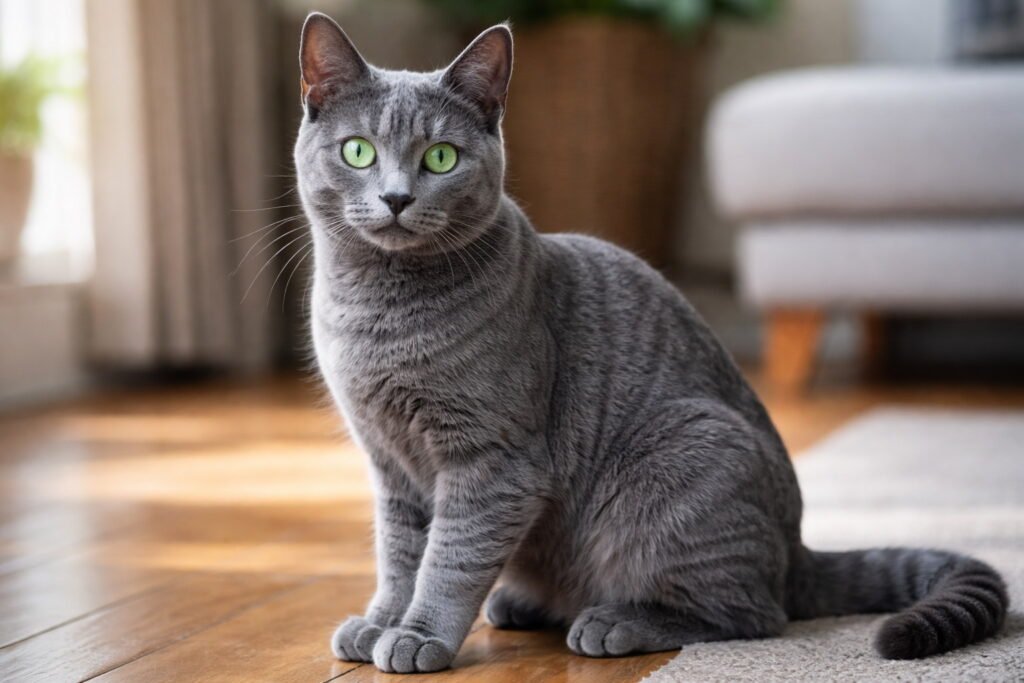
The Russian blue cat with stripes often sparks debate among cat lovers, breeders, and pet owners. Known worldwide for a plush, silvery-blue coat that appears solid at first glance, the Russian Blue sometimes surprises people with faint striping under certain lighting. These subtle patterns raise one central question: Can a Russian Blue actually have stripes without losing its breed identity?
The short answer is yes. A russian blue cat with stripes is real, natural, and genetically explainable. What many observers call “stripes” are usually delicate, low-contrast markings that appear due to underlying genetics rather than mixed breeding. Understanding why this happens requires a deeper look at breed standards, coat structure, and color inheritance.
This article explores the topic clearly and factually, focusing only on what causes striping in Russian Blue cats, how it differs from tabby patterns, and why it is more common than many people realize.
In This Article
The Standard Russian Blue Coat Pattern
A purebred Russian Blue is officially described as having a solid blue coat—blue meaning a diluted black that appears silvery-gray due to light-reflecting hair tips. Breed associations such as CFA and TICA specify several defining coat traits:
- Short, dense, double-layer coat
- Even blue-gray color from root to tip
- Silver tipping that creates a shimmering appearance
- No visible high-contrast patterns in adult show cats
Despite these standards, reality often shows nuance. The coat of a russian blue cat with stripes may appear uniform indoors yet reveal faint banding in bright sunlight. This happens because the coat texture is extremely plush, with each hair standing almost perpendicular to the skin, allowing subtle pigment variations to show.
Visual Characteristics of a Typical Russian Blue Coat
| Feature | Standard Appearance |
| Coat color | Blue-gray with silver tips |
| Pattern | Solid, sometimes with ghost striping |
| Fur density | Very high (double coat) |
| Texture | Soft, plush, springy |
| Shine | Metallic or frosted |
A key distinction exists between true patterns and visual effects. The russian blue cat with stripes usually shows ghost tabby markings, not permanent tabby striping.
“Russian Blues carry hidden tabby genes, which may briefly express themselves visually without altering breed purity.” — Feline Genetics Journal
What Causes a Russian Blue Cat With Stripes?
Striping in a russian blue cat originates from genetics rather than crossbreeding. Every domestic cat inherits a tabby pattern gene at birth. What differs is whether that gene is fully expressed, partially suppressed, or masked by solid-color genes.
Russian Blues possess:
- The dilution gene (dd), turning black pigment into blue
- The non-agouti gene, which suppresses visible tabby patterns
When suppression is incomplete, faint striping becomes visible. This phenomenon explains why kittens and some adults show shadowy patterns on legs, tails, and foreheads.
Common Reasons Stripes Appear
- Kitten coat development: Young Russian Blues often show stripes that fade within 6–12 months
- Lighting conditions: Sunlight enhances contrast in dense coats
- Seasonal shedding: Thinner coats reveal pigment variations
- Individual genetics: Some cats retain visible striping into adulthood
Areas Where Stripes Are Most Visible
- Tail rings
- Leg bands
- Forehead “M” shape
- Flanks in strong light
Ghost Stripes vs True Tabby Markings
| Feature | Ghost Stripes | True Tabby |
| Contrast | Very low | High |
| Permanence | Often fades | Permanent |
| Breed impact | None | Indicates tabby pattern |
| Visibility | Light-dependent | Always visible |
A russian blue cat with stripes remains solid-colored according to genetic classification, even if faint markings persist.
Case insight:
Several CFA-registered Russian Blue cats evaluated for breeding displayed light leg striping under examination lamps yet maintained full breed status because coat texture, eye color, and body type met all standards.
Ghost Tabby Markings in a Russian Blue Cat With Stripes
Ghost tabby markings are the most common reason people notice striping on a russian blue cat with stripes, even when the cat is purebred. These markings are not flaws or abnormalities. Instead, they are faint visual expressions of an underlying tabby pattern that has been genetically muted.
Unlike classic tabby cats, Russian Blues carry the non-agouti gene, which suppresses strong pattern contrast. When suppression is partial, shadow-like stripes remain visible beneath the solid blue coat.
What Ghost Tabby Markings Look Like
Ghost stripes tend to appear as:
- Soft, smoky lines rather than bold markings
- Patterns visible only in certain light or angles
- Low-contrast bands that blend into the coat
The most recognizable ghost tabby features include:
- Slight “M” shape on the forehead
- Narrow rings around the tail
- Faint bands on the legs and shoulders
Why Ghost Stripes Are Common in Russian Blues
Russian Blue kittens almost always show some degree of striping at birth. Pigment cells continue to distribute unevenly during early growth, and coat density changes as the kitten matures.
Key reasons ghost markings persist include:
- Genetic inheritance from solid-line ancestors
- Thick double coat trapping light differently
- Slower pigment stabilization compared to short single coats
“Ghost markings are common in solid-colored breeds and should not be considered tabby expression.” — International Cat Care (iCatCare)
How Ghost Markings Change Over Time
Most Russian Blues experience a reduction in striping as adults. However, a russian blue cat with stripes may retain light markings permanently without any negative implications.
| Age Stage | Visibility of Stripes |
| Newborn kittens | Very noticeable |
| 3–6 months | Moderate, fading |
| Adult | Minimal or faint |
| Senior | May reappear due to coat thinning |
Russian Blue Cat With Stripes vs Blue Tabby Cats
Confusion between a russian blue cat with stripes and a blue tabby is extremely common. At a glance, both may display grayish coats with patterning. Closer inspection reveals clear differences rooted in structure, color consistency, and eye pigmentation.
A blue tabby cat expresses a fully active agouti gene, meaning the stripes are intentional, high-contrast, and genetically dominant. Russian Blues do not express this gene fully, even when ghost striping appears.
Key Physical Differences
| Feature | Russian Blue Cat With Stripes | Blue Tabby Cat |
| Coat pattern | Solid with ghost markings | Defined stripes or swirls |
| Coat texture | Dense, plush, double coat | Short to medium, less dense |
| Eye color | Bright green only | Any eye color |
| Face shape | Wedge-shaped, elegant | Varies by breed |
| Striping contrast | Very subtle | Bold and clear |
Behavioral Differences Often Noted
While coat markings do not define personality, Russian Blues tend to share consistent behavioral traits:
- Reserved yet affectionate
- Loyal to one household member
- Quiet, gentle vocalization
Blue tabbies, being a pattern rather than a breed, display a wide range of temperaments depending on ancestry.
Common Misidentification Scenarios
- Shelter listings labeling ghost-striped Russian Blues as “blue tabbies”
- Owners assuming striping indicates mixed breeding
- Kittens being misclassified before coat maturation
Understanding these differences helps protect breed recognition and prevents misinformation.
Do Stripes Affect Russian Blue Breed Purity?
One of the most persistent myths is that a russian blue cat with stripes is not truly purebred. Breed purity is determined by genetics, lineage, and physical traits—not temporary coat visuals.
What Breeders and Registries Say
Major feline associations agree on several points:
- Ghost striping is allowed in pet-quality Russian Blues
- Adult show cats are judged on overall appearance, not minor pattern visibility
- Temporary striping in kittens is expected and normal
Fact: Many champion-line Russian Blues displayed faint markings as juveniles before their coats fully settled.
Show Standards vs Pet Standards
| Category | Show-Quality | Pet-Quality |
| Coat uniformity | Almost perfectly solid | May show ghost striping |
| Eligibility | Competitive showing | Companion homes |
| Health & temperament | Equal in both | Equal in both |
Stripes do not affect:
- Health
- Lifespan
- Personality
- Intelligence
- Genetic stability
“Visible ghost striping does not disqualify a Russian Blue from being purebred when other traits align.” — TICA Breed Commentary
A russian blue cat with stripes remains just as authentic, affectionate, and valuable as one with a visually solid coat.
Russian Blue Cat With Stripes in Kittens vs Adults
Striping is most commonly observed when a russian blue cat with stripes is still a kitten. Early coat development reveals markings that are far more visible than those seen in mature cats. This stage often causes concern for new owners who expect a perfectly solid coat from the beginning.
Russian Blue kittens are born with softer, thinner fur and uneven pigment distribution. As their signature dense double coat develops, those patterns gradually soften or disappear.
Why Kittens Show More Striping
Several biological factors make stripe visibility higher in young cats:
- Pigment cells are still migrating and stabilizing
- Fur density has not reached full thickness
- Hair tips lack full silvering at early stages
Visible striping peaks between 6 to 12 weeks of age. By the time adulthood arrives, typically around 12 to 18 months, most Russian Blues develop a uniform appearance.
Adult Russian Blue Cats With Persistent Stripes
Some adults retain faint markings throughout life. This does not signal a defect or crossbreeding. Instead, it reflects individual genetic variation.
Common adult stripe locations include:
- Tail rings that never fully fade
- Light leg barring
- Shoulder shadows visible in bright sunlight
Comparison Table: Coat Development Over Time
| Life Stage | Coat Density | Stripe Visibility |
| Newborn | Low | High |
| Juvenile | Medium | Moderate |
| Adult | High | Minimal |
| Senior | Reduced | May increase |
A russian blue cat with stripes remains within breed norms at every stage of development.
Coat Genetics Behind a Russian Blue Cat With Stripes
The genetics responsible for a russian blue cat with stripes are both well-understood and widely documented. Coat color and pattern are controlled by multiple genes interacting simultaneously, not a single on-and-off switch.
Russian Blues carry black pigment genes altered by dilution and pattern suppression mechanisms.
Key Genes Involved
- Black pigment gene (B): Base color foundation
- Dilution gene (dd): Converts black to blue
- Non-agouti gene (a): Suppresses tabby patterns
- Tabby modifier genes: Influence stripe visibility even when suppressed
Partial suppression allows subtle striping to appear beneath the solid-colored coat.
Why Stripes Look Silvery Instead of Dark
Striping on a russian blue cat does not appear black or charcoal like in tabby cats. Instead, it appears lighter or slightly darker than the surrounding fur due to:
- Silver-tipped hairs reflecting light
- High coat density diffusing pigment contrast
- Uniform pigment across hair shafts
Genetics Comparison Table
| Genetic Factor | Russian Blue | Blue Tabby |
| Agouti expression | Suppressed | Fully expressed |
| Pattern contrast | Low | High |
| Hair tip color | Silvered | Neutral |
| Stripe permanence | Often fades | Permanent |
These genetic mechanics explain why stripes can exist without altering breed identity.
Grooming and Coat Care for a Russian Blue Cat With Stripes
Proper care plays a significant role in how a russian blue cat with stripes appears over time. Although grooming cannot remove stripes genetically, it can influence how visible or subtle they seem.
Russian Blues require minimal grooming compared to many breeds, yet consistency makes a noticeable difference.
Best Grooming Practices
- Brush once or twice weekly using a fine rubber brush
- Avoid over-bathing, which strips natural oils
- Use mild, cat-safe grooming products only
- Groom in the direction of hair growth to preserve coat texture
Healthy fur reflects light evenly, reducing contrast between striped and non-striped areas.
Nutrition’s Impact on Coat Appearance
Diet strongly affects fur quality and pigment stability. High-quality protein and fatty acids improve overall coat uniformity.
Key nutrients include:
- Omega-3 and Omega-6 fatty acids
- Biotin and zinc
- Animal-based protein sources
Grooming Impact Table
| Care Factor | Effect on Stripe Visibility |
| Regular brushing | Softens visual contrast |
| Balanced nutrition | Enhances coat uniformity |
| Seasonal shedding | Temporary stripe visibility |
| Stress reduction | Improves pigment health |
A well-cared-for russian blue cat with stripes often appears more polished and evenly colored than one with irregular care routines.
Are Russian Blue Cats With Stripes Rare?
A russian blue cat with stripes is far less rare than many people assume. The perception of rarity often comes from idealized images of perfectly solid-coated Russian Blues seen in show photography or breeder marketing. In real-life conditions, faint striping appears in a noticeable percentage of Russian Blue cats, especially outside the show ring.
How Common Are Stripes in Russian Blues?
Based on breeder observations and feline genetic studies:
- Nearly 70–80% of Russian Blue kittens display some form of ghost striping
- Around 30–40% of adult Russian Blues retain faint visible markings in certain lighting
- Persistent striping is more common in pet-quality lines than show-only lines
These figures reflect natural genetic variation rather than anomalies.
Why Striped Russian Blues Seem Uncommon Online
Several factors influence public perception:
- Studio lighting minimizes stripe visibility
- Selective photo angles hide pattern shadows
- Groomed coats appear more uniform than everyday fur
A russian blue cat with stripes becomes most noticeable in:
- Natural daylight
- High-contrast indoor lighting
- Seasonal coat changes
This explains why many owners first notice striping months or even years after adoption.
Common Myths About Russian Blue Cats With Stripes
Misconceptions surrounding the russian blue cat with stripes persist largely due to limited understanding of feline coat genetics. These myths often lead to unnecessary concern among owners.
Myth vs Fact Breakdown
| Myth | Reality |
| Stripes mean mixed breeding | Ghost stripes appear in purebred Russian Blues |
| Striping indicates poor quality | Coat pattern does not affect health or temperament |
| Adult Russian Blues must be solid | Some adults retain faint markings naturally |
| Stripes reduce value | Companion value remains unchanged |
Why These Myths Persist
Several cultural and industry factors contribute:
- Overemphasis on show standards
- Incomplete breeder explanations
- Online misinformation and mislabeled images
“Coat uniformity is a visual preference, not a biological measure of authenticity.” — Feline Breed Ethics Review
Russian Blues are evaluated holistically. Eye color, coat texture, body structure, and temperament matter far more than faint striping.
Recognizing these facts helps owners appreciate the breed without unrealistic expectations.
Final Thoughts: Appreciating the Russian Blue Cat With Stripes
The russian blue cat with stripes represents the natural diversity found within even the most recognized purebred cats. Subtle striping does not diminish beauty, genetic integrity, or companionship value. Instead, it highlights the complexity of feline genetics and the individuality of each cat.
What Truly Defines a Russian Blue
- Dense, plush double coat
- Silver-tipped blue fur
- Bright emerald-green eyes
- Gentle, intelligent, loyal temperament
Striping exists on a spectrum, ranging from barely noticeable shadows to soft, permanent markings. None of these variations compromise the breed’s core identity.
Why Stripes Should Be Embraced
- They reflect authentic genetic expression
- They add unique character to each cat
- They do not affect health, lifespan, or behavior
Owners often report that discovering faint stripes creates a deeper appreciation for their cat’s individuality rather than disappointment.
For readers interested in authoritative insights into feline coat genetics and breed standards, a trusted and well-researched resource can be found at the International Cat Care website:
https://icatcare.org
A russian blue cat with stripes remains, in every meaningful way, a true Russian Blue—elegant, intelligent, and quietly distinctive.