
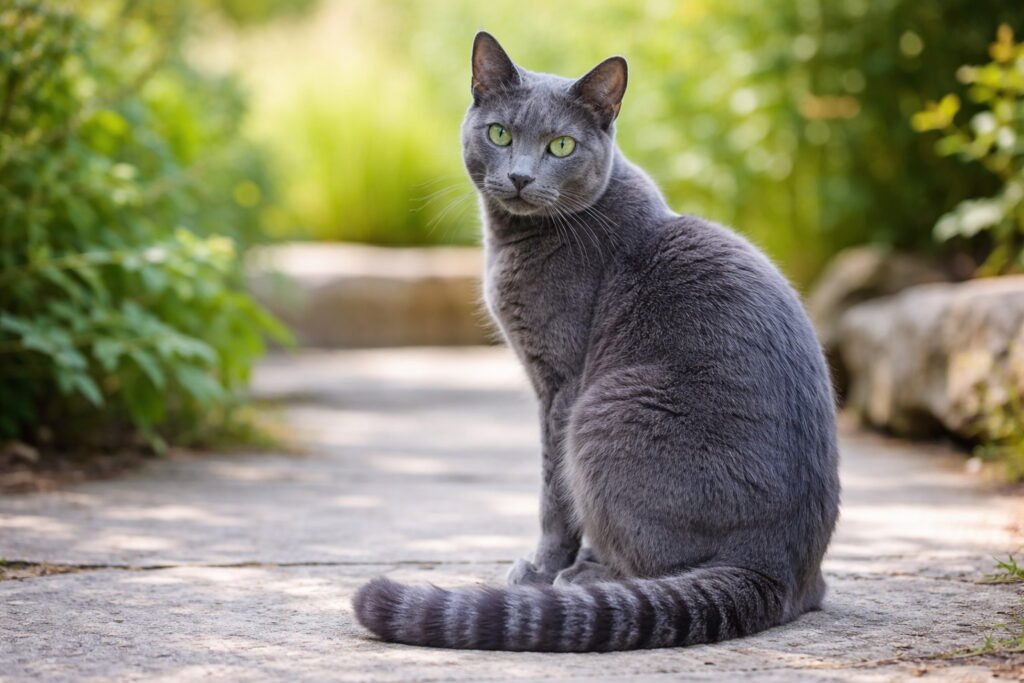
The russian blue cat striped tail often surprises owners who expect a perfectly solid blue-gray coat from this famously elegant breed. At first glance, faint rings or shadowy bands on the tail can raise questions about purity, genetics, or even mixed ancestry. In reality, these subtle markings are both natural and well-documented within the breed.
Russian Blue cats are known for their plush double coats, silver-tipped fur, vivid green eyes, and refined body structure. Despite their solid-color reputation, many Russian Blues display delicate tail striping that becomes visible under certain lighting conditions or life stages. Rather than being a flaw, the striped tail tells an interesting story about feline genetics and coat development.
This article explores the science, history, and real-world observations behind the russian blue cat striped tail, offering clear facts and practical insight without drifting off-topic.
In This Article
What Makes the Russian Blue Cat Striped Tail Unique
The russian blue cat striped tail stands out because it contrasts gently with the rest of the cat’s uniform coat. These stripes are not bold or high-contrast like those of a tabby. Instead, they appear as soft rings, shadows, or darker bands that often blend seamlessly into the tail’s plush fur.
Key visual characteristics of a Russian Blue striped tail
- Subtle, low-contrast rings rather than sharp stripes
- Darker slate or charcoal tones over a blue-gray base
- More noticeable under direct sunlight or bright indoor lighting
- Often confined to the tail, not the body
Many owners notice that the tail markings seem to “appear and disappear” depending on grooming, lighting, or coat condition. This optical effect happens because Russian Blue fur has silver-tipped guard hairs, which reflect light unevenly along the tail.
How the tail differs from the body coat
| Feature | Body Coat | Tail Coat |
| Color consistency | Highly uniform blue-gray | Slight tonal variation |
| Pattern visibility | Nearly solid | Faint striping may show |
| Hair density | Dense double coat | Slightly longer outer hairs |
| Light reflection | Even silver sheen | Variable highlights |
The tail acts like a visual accent, revealing underlying patterning that remains hidden on the torso due to denser fur and uniform hair length.
“Many solid-colored cats carry hidden patterns that only reveal themselves in specific areas, especially the tail.”
— Feline coat genetics reference
Genetics Behind the Russian Blue Cat Striped Tail
The presence of a russian blue cat striped tail is rooted in genetics rather than breeding errors. All domestic cats genetically descend from patterned ancestors. Solid-colored cats, including Russian Blues, still carry these pattern genes beneath their coat color.
The role of ghost tabby markings
Russian Blues typically possess what geneticists call ghost tabby markings. These are faint remnants of tabby striping that persist even when a cat carries genes for a solid coat.
Important genetic factors include:
- Agouti gene suppression, which hides body striping
- Tabby pattern genes, still present at a genetic level
- Tail-specific expression, where patterns remain visible
The tail often reveals these ghost markings first because hair structure and growth patterns differ slightly from the rest of the body.
Why purebred Russian Blues still show stripes
Tail striping does not indicate impurity. Even championship bloodlines can show faint tail rings.
Fact-based clarity:
- Russian Blue coat color: blue (dilute black)
- Genetic base color: black
- Tabby genes: always present in domestic cats
This explains why kittens often show stronger markings early in life, which may soften as the adult coat fully matures.
Common myths vs. genetic reality
| Myth | Reality |
| Striped tail means mixed breed | Purebred Russian Blues can have it |
| Stripes are a fault | Breed standards allow faint tail rings |
| Markings always fade | Some remain subtle for life |
| Diet causes striping | Genetics determines pattern presence |
Understanding the genetic basis removes unnecessary concern and helps owners appreciate the natural beauty of this feature.
Kitten Development and the Russian Blue Cat Striped Tail
The russian blue cat striped tail is often most noticeable during the kitten stage. Russian Blue kittens are rarely born with a perfectly uniform coat. Instead, their early fur commonly displays soft striping, especially around the tail, legs, and forehead.
Why Russian Blue kittens show stronger tail stripes
Several biological factors influence early coat patterns:
- Immature pigment distribution in growing fur
- Faster hair turnover in kittens compared to adults
- Incomplete development of the dense double coat
Young Russian Blues frequently display what breeders refer to as “kitten barring”, where faint rings are visible along the tail. These markings tend to fade gradually as the adult coat thickens and pigment evens out.
Age timeline of tail stripe visibility
| Age Range | Tail Stripe Appearance |
| Birth to 8 weeks | Clearly visible rings or shadow bands |
| 3 to 6 months | Stripes begin to soften and blur |
| 7 to 12 months | Adult coat emerging, markings reduce |
| 12+ months | Very faint or subtly persistent stripes |
Some cats retain tail striping throughout life, especially in certain lighting. This persistence remains normal and acceptable within the breed.
“Kitten markings are a window into a cat’s genetic blueprint.”
— Breeder observation from Russian Blue lineage studies
Is a Russian Blue Cat Striped Tail a Sign of Mixed Breeding?
The presence of a russian blue cat striped tail is one of the most misunderstood traits among cat owners. Many assume stripes indicate crossbreeding, though feline genetics prove otherwise.
How breeders assess purebred Russian Blues
Professional breeders evaluate multiple traits together, not isolated markings:
- Eye color (deep, vivid green in adults)
- Coat texture (short, plush, dense double coat)
- Body structure (fine-boned, muscular, elegant)
- Head shape (modified wedge with smooth contours)
A striped tail alone does not outweigh these defining characteristics.
Breed standard tolerance for tail striping
Major cat associations accept faint tail rings as long as they do not disrupt overall solid appearance.
Acceptable features include:
- Subtle tail rings
- Slight shading at tail tip
- Ghost markings visible only in bright light
Disqualifying factors generally involve strong, high-contrast tabby patterns across the body, not a lightly striped tail.
Case insight from breeders
Case study:
A registered Russian Blue kitten from two champion parents showed clear tail striping at four months. By fourteen months, the stripes faded into a faint smoky gradient. The cat later earned show awards without penalty.
This example highlights how coat development over time matters more than early appearance.
How Common Is the Russian Blue Cat Striped Tail?
The russian blue cat striped tail is more common than many realize. While not every Russian Blue shows visible striping, a significant percentage displays some degree of tail patterning at some point in life.
Prevalence among Russian Blue cats
| Level of Tail Striping | Estimated Occurrence |
| Strong in kittens | Very common |
| Moderate in adolescents | Common |
| Subtle in adults | Fairly common |
| Completely invisible | Less common |
Lighting, coat condition, and grooming practices strongly influence stripe visibility. A well-groomed, healthy coat reflects light more evenly, which can either highlight or soften tail markings.
Comparison with similar blue-coated breeds
- Russian Blue – soft, low-contrast tail stripes
- Chartreux – thicker body, stripes less common
- British Shorthair (Blue) – occasional tail rings, heavier coat
The Russian Blue’s unique coat texture and silver tipping make even minor pigment variation more visible, especially on the tail.
“Variation within solid coats is natural, not an exception.”
— Feline coat pattern research summary
Russian Blue Cat Striped Tail vs. Tabby Tail Patterns
The russian blue cat striped tail is often mistaken for a tabby trait, yet the two patterns differ significantly in structure, contrast, and genetic expression. Understanding these differences helps owners accurately identify what they are seeing.
Visual comparison between Russian Blue and tabby tail stripes
| Feature | Russian Blue Cat Striped Tail | Classic Tabby Tail |
| Stripe contrast | Soft and low-contrast | Bold and high-contrast |
| Pattern edges | Blended, smoky | Sharp and clearly defined |
| Stripe spacing | Irregular, subtle | Evenly spaced |
| Coat base color | Blue-gray with silver tips | Brown, gray, orange, or silver |
| Visibility in dim light | Often disappears | Remains visible |
Tabby tails display distinct rings caused by active agouti gene expression. Russian Blue tails, by contrast, show ghost markings that emerge only when light interacts with fur layers.
Why Russian Blue tail stripes never form tabby patterns
Ghost markings lack:
- The bold “M” marking on the forehead
- Clear body striping or spots
- Strong contrast between bands
These distinctions confirm that a striped tail in Russian Blues remains a coat variation, not a tabby classification.
“A striped tail alone does not define a tabby cat.”
— Standard feline phenotype guideline
Grooming and Care for a Russian Blue Cat Striped Tail
Proper grooming enhances the natural beauty of the russian blue cat striped tail without altering its genetic pattern. Coat health plays a direct role in how visible or muted tail striping appears.
Grooming practices that support coat quality
- Weekly brushing using a soft bristle or rubber brush
- Occasional damp cloth wipe to remove fine dust
- Gentle detangling at the tail base to prevent mats
Harsh grooming tools should be avoided, as they can damage the silver-tipped guard hairs that create the Russian Blue’s signature sheen.
Nutrition and coat appearance
Diet influences shine, density, and pigment clarity, even though it does not create stripes.
Essential dietary elements include:
- High-quality animal protein (minimum 30–35%)
- Omega-3 and Omega-6 fatty acids
- Adequate zinc and biotin levels
Coat care impact table
| Care Factor | Effect on Tail Appearance |
| Balanced diet | Enhanced silver sheen |
| Regular grooming | More even color reflection |
| Stress reduction | Reduced shedding and dullness |
| Clean environment | Cleaner, brighter fur |
A healthy coat allows subtle tail markings to appear refined rather than patchy or dull.
Does the Russian Blue Cat Striped Tail Change Over Time?
The russian blue cat striped tail often evolves throughout a cat’s life, shaped by age, seasonal shifts, and coat cycles.
How age influences tail striping
- Kittens show more noticeable bands
- Adolescents experience stripe softening
- Adults display subtle or occasional striping
- Seniors may see slight pattern re-emergence due to coat thinning
Seasonal shedding cycles can also temporarily make stripes more visible when old fur gives way to new growth.
Environmental and health-related influences
Factors that affect stripe visibility include:
- Exposure to natural sunlight
- Indoor climate and humidity
- Stress levels affecting shedding
- Overall skin and follicle health
“Coat patterns are genetically fixed, but their visibility is dynamic.”
— Veterinary dermatology insight
Long-term expectation summary
| Life Stage | Stripe Visibility Trend |
| Kittenhood | Prominent |
| Early adulthood | Subtle |
| Mid-life | Stable and faint |
| Senior years | May vary slightly |
These natural changes do not indicate health issues and fall well within expected breed behavior.
Breed Standards and Acceptance of the Russian Blue Cat Striped Tail
The russian blue cat striped tail is widely accepted within established breed standards when it appears subtly and does not interrupt the overall solid blue appearance of the cat. Major feline associations emphasize coat texture, color uniformity, and physical structure over faint pattern remnants.
What official breed standards allow
Russian Blue standards describe the ideal coat as blue with silver tipping, plush, and even in tone. They also acknowledge natural variations.
Commonly accepted features include:
- Faint rings on the tail
- Slightly darker tail tip
- Ghost striping visible only in strong light
Disqualifications focus on obvious tabby patterning across the body, not delicate tail striping.
How judges evaluate tail markings
Judges assess:
- Overall coat impression from a distance
- Balance between color, sheen, and texture
- Visibility of markings under normal lighting
A lightly striped tail that blends naturally into the coat is rarely penalized.
| Evaluation Factor | Importance |
| Coat texture | Very high |
| Eye color clarity | High |
| Body structure | High |
| Tail striping | Low |
This approach reinforces the idea that the striped tail is a minor cosmetic detail, not a defect.
Frequently Asked Questions About the Russian Blue Cat Striped Tail
Is the russian blue cat striped tail normal?
Yes. Many purebred Russian Blue cats show faint tail stripes caused by ghost tabby genes. This is normal and well-documented within the breed.
Will the stripes disappear completely?
Some Russian Blues lose visible striping as the adult coat matures, while others keep subtle markings for life. Both outcomes remain normal.
Can grooming or diet remove the stripes?
Grooming and nutrition improve coat quality and shine but cannot eliminate genetically determined patterns. They may only affect visibility.
Does tail striping affect health or lifespan?
No connection exists between a striped tail and health issues. Russian Blues typically live 15–20 years when properly cared for, regardless of tail markings.
Are striped tails more common in females or males?
Sex does not influence the appearance of tail stripes. Occurrence rates remain similar across both genders.
Final Thoughts on the Russian Blue Cat Striped Tail
The russian blue cat striped tail is a fascinating expression of feline genetics rather than a cause for concern. Instead of detracting from the breed’s elegance, these subtle markings add depth and individuality to an already refined appearance.
Owners who notice faint tail rings can feel confident knowing:
- The trait is genetically normal
- Breed standards allow subtle striping
- Coat appearance may change naturally over time
- Health and purity remain unaffected
Rather than striving for visual uniformity, embracing these natural variations highlights the beauty of the Russian Blue as a living, evolving animal.
For further understanding of coat genetics and feline patterns, reliable resources such as the Cornell Feline Health Center provide detailed scientific insight into how and why these markings appear:
https://www.vet.cornell.edu/departments-centers-and-institutes/cornell-feline-health-center
The Russian Blue’s charm lies not in perfection, but in its subtle, shimmering details.