
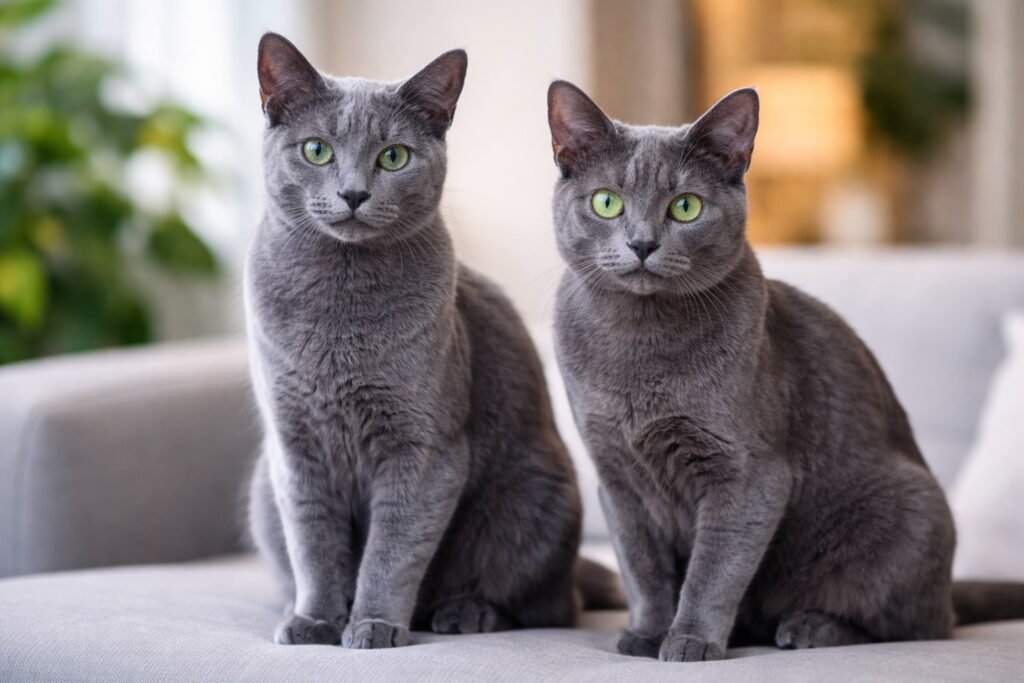
Understanding the difference between Russian Blue and Korat helps cat lovers make informed decisions, especially since both breeds share a striking blue-gray appearance. Despite visual similarities, these cats differ in origin, personality, coat texture, and long-term compatibility with owners. This guide explores those differences in depth, using clear facts, expert insight, and easy-to-read comparisons to highlight what truly sets them apart.
In This Article
Difference Between Russian Blue and Korat
Many people mistake the Russian Blue and Korat as the same breed due to their short blue coats and elegant build. That assumption often leads to confusion when choosing the right companion. In reality, centuries of separate development shaped these cats into distinct breeds with unique traits.
Both breeds are intelligent, loyal, and affectionate, yet their behavior and care needs vary in noticeable ways. Learning the real difference between Russian Blue and Korat ensures expectations match reality, especially for families, apartment dwellers, and first-time cat owners.
“Two cats can share the same color yet tell very different stories.”
This article focuses strictly on factual, practical differences, helping readers recognize which breed fits their lifestyle best.
Breed Origins: Historical Difference Between Russian Blue and Korat
Russian Blue Breed History
Russian Blues originated in northwestern Russia, specifically around the port city of Arkhangelsk. Harsh winters influenced the breed’s development, resulting in a dense double coat that provides insulation.
Historical records suggest sailors introduced Russian Blues to Europe in the mid-1800s, where selective breeding refined their sleek body and calm demeanor. Formal recognition by cat registries occurred in the early 20th century.
Key origin facts:
- Country of origin: Russia
- Climate influence: Cold environments
- Recognition period: Early 1900s
- Purpose: Companion animal
Korat Breed History
Korats come from Thailand, formerly known as Siam. Local tradition views Korats as symbols of good luck and prosperity, often gifted in pairs during weddings. Unlike many modern breeds, Korats evolved naturally without crossbreeding.
Written records in the ancient Tamra Maew manuscripts date Korats back over 700 years, making them one of the oldest established cat breeds.
Key origin facts:
- Country of origin: Thailand
- Cultural role: Symbol of fortune
- Development: Natural landrace
- Recognition period: 1950s internationally
Historical Comparison Table
| Trait | Russian Blue | Korat |
| Geographic origin | Russia | Thailand |
| Climate adaptation | Cold | Tropical |
| Cultural symbolism | Elegant companion | Good luck charm |
| Breed development | Selective breeding | Natural evolution |
Historical background explains why the difference between Russian Blue and Korat appears not only in looks but also in behavior and sensitivity.
Physical Appearance: Key Difference Between Russian Blue and Korat
Body Structure and Size
Russian Blues feature a lean, long-legged body with fine bone structure. Adult weight typically ranges between 3.6–5.4 kg (8–12 lb). Their posture creates an elegant, almost regal silhouette.
Korats possess a more compact and muscular build. Average adult weight ranges from 3–4.5 kg (6–10 lb). Muscle mass feels surprisingly solid when handled.
Face Shape and Head Structure
Facial structure provides one of the clearest visual clues to the difference between Russian Blue and Korat.
- Russian Blue
- Wedge-shaped head
- Straight nose profile
- Large ears set wide apart
- Korat
- Distinct heart-shaped face
- Pronounced brow ridge
- Rounded muzzle
Eyes and Color Development
Eye color differs dramatically between the two breeds.
- Russian Blue kittens develop vivid green eyes by adulthood, often described as emerald or jade.
- Korat eyes begin amber and mature into a brilliant peridot green, deeper and more intense with age.
Coat Texture and Color Tone
Despite both appearing blue-gray, coat structure varies:
| Feature | Russian Blue | Korat |
| Coat layers | Double coat | Single coat |
| Texture | Plush, dense | Smooth, close-lying |
| Silver tipping | Strong shimmer | Minimal shimmer |
| Shedding level | Low | Very low |
Russian Blues often appear larger due to their dense coat, while Korats show a sleeker outline that emphasizes muscle tone.
Veterinary genetic studies confirm that coat density alone can create the illusion of size, especially in cold-adapted breeds.
Coat and Grooming Needs: Difference Between Russian Blue and Korat
Coat Structure and Maintenance Requirements
A clear difference between Russian Blue and Korat appears when examining coat structure. Russian Blues possess a dense double coat, where the guard hairs and undercoat stand out from the body, giving a plush, velvety feel. Korats, by contrast, have a single, close-lying coat that feels smooth and cool to the touch.
Because of these structural differences, grooming routines vary slightly between the two breeds.
Russian Blue coat facts
- Double-layered coat traps air for insulation
- Natural silver tipping creates a frosted appearance
- Mild seasonal shedding
Korat coat facts
- Single-layer coat lies flat against the body
- Pure blue-gray color without heavy silvering
- Extremely low shedding
Grooming Frequency Comparison
Routine grooming keeps both breeds healthy and polished, yet effort levels remain minimal.
| Grooming Factor | Russian Blue | Korat |
| Brushing frequency | 1–2 times per week | Once per week |
| Bathing need | Rare | Rare |
| Shedding control | Moderate-low | Very low |
| Allergy friendliness | Often tolerated | Often tolerated |
Russian Blues benefit from weekly brushing to maintain coat volume. Korats need occasional brushing primarily to distribute skin oils.
“Less grooming does not mean less care; it means smarter coat management.”
Owners seeking a clean, low-maintenance companion often notice this practical difference between Russian Blue and Korat early on.
Personality and Temperament Difference Between Russian Blue and Korat
Social Behavior and Attachment Style
Temperament highlights one of the most meaningful aspects of the difference between Russian Blue and Korat.
Russian Blues form strong bonds but remain reserved with strangers. Loyalty tends to center on one or two people, creating a calm, quietly affectionate presence.
Korats display intense emotional attachment and prefer constant human interaction. Many Korat owners describe them as “emotionally intuitive” cats that shadow their people from room to room.
Energy Levels and Daily Behavior
Behavior patterns vary significantly between these breeds.
Russian Blue temperament traits
- Calm and observant
- Enjoys structured routines
- Comfortable with alone time
Korat temperament traits
- Energetic and curious
- Thrives on engagement
- Dislikes isolation
This difference influences household compatibility, especially in busy homes.
Sensitivity and Environmental Awareness
Environmental sensitivity explains why Korats may struggle with frequent changes.
- Russian Blues adapt well to predictable households
- Korats react strongly to stress, loud noise, or abrupt routine shifts
“Korats don’t just live with you — they emotionally invest in you.”
Families seeking a serene companion often gravitate toward Russian Blues, while Korats suit owners wanting constant interaction and emotional connection.
Intelligence and Trainability: Difference Between Russian Blue and Korat
Problem-Solving and Cognitive Skills
Both breeds rank high in feline intelligence, yet express it differently.
Russian Blues demonstrate quiet problem-solving abilities. Puzzle toys, treat mazes, and interactive feeders stimulate their analytical nature.
Korats exhibit curiosity-driven intelligence, learning by exploration and experimentation.
Response to Training and Commands
Training sessions reveal subtle contrasts in learning style.
| Intelligence Aspect | Russian Blue | Korat |
| Training response | Calm, methodical | Fast, enthusiastic |
| Clicker training | Very effective | Highly effective |
| Toy interaction | Strategic play | Energetic play |
| Routine learning | Strong | Strong |
Russian Blues excel with repetition and structure. Korats respond best to praise, voice, and interactive play.
Human Interaction and Mental Engagement
Mental stimulation plays a critical role in overall well-being.
- Russian Blues enjoy scheduled play followed by rest
- Korats require ongoing engagement throughout the day
Failing to provide stimulation for a Korat may lead to vocalization or clingy behavior, a notable behavioral difference between Russian Blue and Korat that owners should consider carefully.
Health and Lifespan: Difference Between Russian Blue and Korat
Overall Health Profiles
Health distinctions form another important difference between Russian Blue and Korat, especially for long-term ownership planning. Both breeds are considered generally healthy, yet genetic backgrounds influence potential risks.
Russian Blues benefit from a broad gene pool due to careful outcrossing during breed development. Korats, as a naturally preserved landrace, have a smaller genetic base, which raises the importance of ethical breeding.
Common Health Conditions Compared
| Health Aspect | Russian Blue | Korat |
| Average lifespan | 15–20 years | 15–18 years |
| Genetic risk level | Low | Moderate |
| Notable conditions | Obesity risk if inactive | GM1 & GM2 gangliosidosis |
| Vet care complexity | Standard preventive care | Requires genetic screening |
Russian Blue health notes
- Prone to weight gain if overfed
- Strong immune system
- Excellent longevity with balanced diet
Korat health notes
- Risk of inherited neurological disorders without testing
- Sensitive digestive system
- Excellent health when sourced from reputable breeders
Responsible breeders routinely test Korats to eliminate inherited neurological diseases.
This health-focused difference between Russian Blue and Korat underscores why breeder selection matters more for Korats than for many other cat breeds.
Living Environment and Compatibility Difference Between Russian Blue and Korat
Home Environment Suitability
Environmental preferences reveal practical lifestyle implications in the difference between Russian Blue and Korat.
Russian Blues adapt well to:
- Apartments
- Quiet households
- Predictable schedules
Korats thrive in:
- Interactive homes
- Families with constant presence
- Environments rich in stimulation
Compatibility With Children and Other Pets
Social tolerance varies between the breeds.
Russian Blue compatibility
- Gentle with respectful children
- Accepts other pets gradually
- Values personal space
Korat compatibility
- Highly bonded with family members
- Can be possessive of owners
- Prefers to be the primary pet
Homes with multiple pets often find Russian Blues easier to integrate. Korats perform best as single companions or in carefully managed multi-cat homes.
Indoor Lifestyle Adaptability
Both breeds are suited to indoor life, yet their needs differ.
- Russian Blues require vertical spaces and quiet observation points
- Korats need daily interactive play and companionship
Meeting these needs supports emotional balance and reduces stress-related behaviors.
Choosing the Right Breed: Final Thoughts on the Difference Between Russian Blue and Korat
Selecting between these two remarkable breeds depends on understanding the full difference between Russian Blue and Korat, not just appearance.
Breed Selection Guide
Choose a Russian Blue if:
- You value calm elegance and quiet companionship
- Your schedule includes regular alone time
- You prefer a low-drama, independent cat
Choose a Korat if:
- You want deep emotional bonding
- Someone is home most of the day
- You enjoy an expressive, people-focused cat
“A Russian Blue shares your space gracefully. A Korat shares your life passionately.”
Reliable breed standards and health recommendations can be found through trusted authorities such as the Cat Fanciers’ Association, which maintains detailed, up-to-date breed profiles and welfare guidelines: https://cfa.org
Understanding the real difference between Russian Blue and Korat ensures not only a better match but a more fulfilling, long-lasting relationship for both cat and owner.