
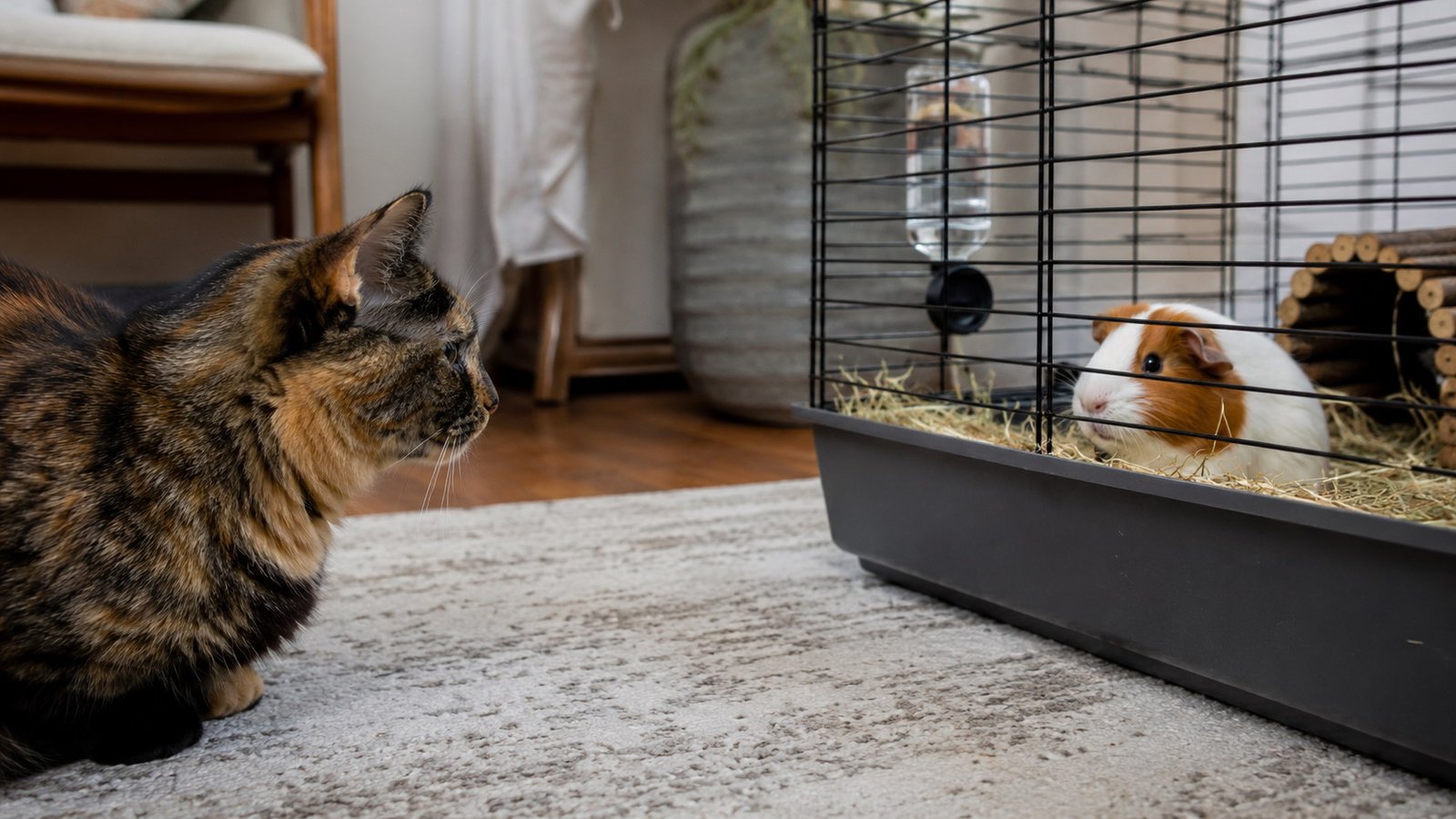
Many pet owners wonder: do guinea pigs get along with cats? The short answer is sometimes, but only under careful supervision. Some cats ignore guinea pigs completely, while others see them as prey because of their natural hunting instincts.
Even the calmest cat can accidentally injure or severely stress a guinea pig. That does not mean the two pets can never live in the same home, but it does mean owners need realistic expectations, proper setup, and strict safety precautions.
This guide explains how cats and guinea pigs interact, the risks involved, signs of stress or aggression, and the safest ways to manage a multi-pet household.
In This Article
Quick Answer: Can Guinea Pigs and Cats Live Together?
Yes, guinea pigs and cats can live in the same household, but they should not be left together unsupervised.
Guinea pigs are prey animals, while cats are predators by nature. Some cats behave gently around guinea pigs, especially older or less prey-driven cats, but others may stalk, swat, or attack.
For safety:
- Keep guinea pigs in a secure enclosure with a strong lid
- Supervise all interactions
- Never assume a cat is “safe” just because it seems calm
- Watch for signs of stress in the guinea pig
- Give both animals separate spaces
In most homes, peaceful coexistence is more realistic than true friendship.
Understanding the Natural Instincts of Cats and Guinea Pigs
To understand whether guinea pigs and cats can get along, it helps to look at how these animals evolved.
Guinea Pigs Are Prey Animals
Guinea pigs survive in the wild by staying alert and avoiding predators. Their instincts tell them to fear:
- Sudden movements
- Loud noises
- Large animals hovering above them
- Staring or stalking behavior
Because of this, even a friendly cat can make a guinea pig feel threatened.
Stress in guinea pigs is more serious than many owners realize. Chronic fear can lead to:
- Reduced appetite
- Weight loss
- Hiding constantly
- Weak immune response
- Digestive issues
Cats Are Natural Hunters
Domestic cats retain hunting instincts even when they are well-fed.
A cat may:
- Chase moving objects
- Paw at small animals
- Stalk silently
- Bite during play
The problem is that “play” from a cat can still seriously injure a guinea pig. Guinea pigs have delicate bones and sensitive skin, making them vulnerable to scratches and bites.
Even a small scratch from a cat can become dangerous because cat saliva and claws contain bacteria that may cause infection.
Can Cats and Guinea Pigs Become Friends?
Sometimes cats appear affectionate toward guinea pigs. You may see videos online of cats lying near guinea pigs peacefully.
However, these situations can be misleading.
What Usually Happens
In many successful multi-pet homes:
- The cat becomes accustomed to the guinea pig’s presence
- The guinea pig learns the cat is not actively attacking
- Both animals ignore each other most of the time
This is tolerance rather than friendship.
Why Viral Videos Can Be Risky
Social media often shows unusual or carefully controlled moments. What viewers do not see includes:
- Constant supervision
- Edited footage
- Separate housing arrangements
- Stress signals from the guinea pig
Copying those situations without caution can lead to injuries.
Are Some Cats Safer Around Guinea Pigs?
Yes, temperament matters.
Some cats are less likely to behave aggressively toward guinea pigs.
Cats More Likely to Be Calm
Generally, these cats may adapt better:
- Older cats
- Lazy or low-energy cats
- Cats raised around small animals
- Cats with low prey drive
Cats More Likely to Be Risky
Extra caution is needed with:
- Kittens
- Highly energetic cats
- Outdoor hunting cats
- Cats that chase toys obsessively
- Cats with strong prey instincts
Still, no cat should ever be considered completely risk-free around guinea pigs.
Signs Your Guinea Pig Is Stressed by the Cat
A guinea pig does not need to be physically attacked to suffer from fear.
Watch for these warning signs:
| Stress Sign | What It May Mean |
| Freezing in place | Fear or panic |
| Constant hiding | Feeling unsafe |
| Teeth chattering | Anxiety or irritation |
| Refusing food | Severe stress |
| Rapid breathing | Fear response |
| Excessive squealing | Distress |
| Hair loss | Chronic stress |
| Aggressive behavior | Feeling threatened |
If your guinea pig consistently acts nervous when the cat is nearby, the pets should be separated more carefully.
Signs a Cat May Be Unsafe Around Guinea Pigs
Some cat behaviors suggest the situation is unsafe.
Watch for:
- Intense staring
- Crouching and stalking
- Tail twitching while focused on the cage
- Pawing at the enclosure
- Trying to open the cage
- Chasing during floor time
- Biting attempts
These are predator behaviors, not curiosity.
How to Safely Keep Guinea Pigs and Cats in the Same Home
The safest approach is management and prevention.
Use a Secure Guinea Pig Enclosure
Your guinea pig’s cage should be:
- Sturdy
- Escape-proof
- Difficult for cats to access
- Covered with a strong lid
Wire cube cages without tops are risky in homes with cats.
A good enclosure should prevent:
- Paw access
- Climbing access
- Jumping into the cage
Best Cage Placement
Place the enclosure:
- In a quieter room
- Away from cat climbing shelves
- Off the floor if possible
- Away from stressful traffic areas
Avoid placing the cage directly beside cat sleeping spots or windows where neighborhood cats appear frequently.
Never Leave Them Unsupervised Together
This is the most important rule.
Even cats that have behaved gently for years can react unpredictably.
A startled cat may:
- Swat suddenly
- Jump onto the guinea pig
- Trigger panic injuries
Supervision means active attention — not simply being in the same room while distracted.
Introduce Them Slowly
If you want the animals to become accustomed to each other, gradual exposure works best.
Step-by-Step Introduction
- Keep them completely separate at first
- Allow the cat to observe the enclosure from a distance
- Reward calm behavior from the cat
- Watch the guinea pig’s stress levels carefully
- Gradually reduce distance over several days or weeks
- End interactions immediately if either pet becomes stressed
Never force interaction.
Provide Safe Hiding Spaces
Guinea pigs need places where they feel protected.
Include:
- Hide houses
- Tunnels
- Covered areas
- Fleece forests
- Multiple shelters in shared cages
A guinea pig that cannot hide may experience constant anxiety around cats.
Keep the Cat Mentally Stimulated
A bored cat is more likely to obsess over small animals.
Help reduce prey-focused behavior with:
- Daily play sessions
- Puzzle feeders
- Climbing trees
- Interactive toys
- Scheduled exercise
Tired cats are generally calmer.
Common Mistakes Owners Make
Many accidents happen because owners misread animal behavior.
Assuming Curiosity Means Safety
A cat staring quietly at a guinea pig may actually be hunting mentally.
Predators often appear calm before striking.
Letting the Cat Inside the Cage
This is extremely risky.
Even gentle contact can:
- Frighten the guinea pig
- Cause scratches
- Spread bacteria
The enclosure should remain the guinea pig’s safe zone.
Ignoring Stress Signals
Some guinea pigs become silent when terrified.
Owners sometimes mistake freezing behavior for calmness.
Trusting Internet Videos Too Much
Every animal is different.
A relationship that works in one household may fail badly in another.
Can Guinea Pigs Hurt Cats?
Not usually.
Guinea pigs are not aggressive predators.
However, they may:
- Nip when frightened
- Scratch while struggling
- Spread parasites or illness if hygiene is poor
The greater danger almost always goes in the opposite direction: cat to guinea pig.
What Happens if a Cat Scratches a Guinea Pig?
Even small scratches can become emergencies.
Cat claws and saliva contain bacteria that may cause serious infections in guinea pigs.
Signs of trouble include:
- Swelling
- Bleeding
- Limping
- Lethargy
- Refusing food
- Difficulty breathing
If a cat injures a guinea pig in any way, contact an exotic veterinarian immediately.
Are Kittens Safer Than Adult Cats?
Not necessarily.
Kittens are often:
- More energetic
- Less predictable
- More likely to pounce
- More playful in rough ways
Adult cats are usually calmer, though prey drive varies widely.
Do Guinea Pigs Ever Stop Being Afraid of Cats?
Some guinea pigs become more relaxed over time, especially if:
- The cat behaves calmly
- The environment stays predictable
- The guinea pig has safe hiding areas
- Interactions are limited and controlled
Others remain fearful permanently.
Personality matters just as much as species.
Best Practices for Multi-Pet Homes
Here are the safest long-term strategies.
Recommended Safety Checklist
| Best Practice | Why It Matters |
| Use a cage with a secure lid | Prevents physical access |
| Supervise interactions | Reduces accident risk |
| Keep separate safe zones | Prevents chronic stress |
| Watch body language | Detects problems early |
| Give guinea pigs hiding places | Helps them feel secure |
| Enrich the cat’s environment | Reduces hunting behavior |
| Never force bonding | Lowers anxiety |
Should You Let a Cat and Guinea Pig Play Together?
In most cases, no.
The size difference and predator-prey relationship make true “play” unsafe.
What looks playful can quickly become dangerous because:
- Cats use claws instinctively
- Guinea pigs frighten easily
- One sudden movement can trigger chasing
Short, supervised coexistence is safer than direct interaction.
What to Do if Your Cat Is Obsessed With the Guinea Pig Cage
Some cats become fixated on guinea pigs.
If this happens:
- Move the cage to a separate room
- Use barriers or baby gates
- Increase cat enrichment and exercise
- Cover parts of the enclosure if visual stimulation worsens stalking
- Prevent access entirely if behavior continues
Persistent stalking usually means the environment is too stressful for the guinea pig.
Do Guinea Pigs Get Lonely Without Other Guinea Pigs?
Yes. Guinea pigs are highly social animals and generally do best with other guinea pigs.
Cats should never be considered a substitute companion.
If possible, guinea pigs should live with:
- Another compatible guinea pig
- Proper introductions
- Adequate cage space
Human interaction and other species cannot fully replace guinea pig companionship.
FAQ About Guinea Pigs and Cats
Can cats kill guinea pigs?
Yes. Even a single bite or swat can seriously injure or kill a guinea pig.
Can guinea pigs and cats cuddle safely?
It is not recommended. Even calm cats can react unpredictably.
Are some guinea pigs less afraid of cats?
Yes. Some guinea pigs are naturally bolder, while others are very timid.
Should I keep my guinea pig in my bedroom if I have a cat?
A separate room can help reduce stress and improve safety, especially at night.
Can a cat sitting near the cage stress a guinea pig?
Yes. Constant staring or lingering near the enclosure can create chronic fear.
Is it safe if my cat ignores the guinea pig?
That is a positive sign, but supervision and physical separation are still important.
Quick Summary
Here is the short version:
- Guinea pigs and cats can sometimes coexist peacefully
- They should never be fully trusted alone together
- Guinea pigs are prey animals and may feel stressed around cats
- Even gentle cats can accidentally injure guinea pigs
- Secure housing and supervision are essential
- Most successful homes focus on safe separation rather than close interaction
Final Thoughts on Whether Guinea Pigs Get Along With Cats
So, do guinea pigs get along with cats? Sometimes — but usually through careful management rather than genuine companionship.
Some cats learn to ignore guinea pigs completely, while others remain highly interested in them. The biggest factor is safety. Guinea pigs are fragile prey animals, and even minor incidents can become serious quickly.
The best approach is to create a calm, secure environment where both pets can live comfortably without unnecessary risk. With proper supervision, secure enclosures, and realistic expectations, many households successfully keep guinea pigs and cats under the same roof while keeping stress and danger to a minimum.

Passionate about pets and animal care, we shares trusted tips, fun facts, and practical advice to help pet lovers give their furry, feathered, and scaly companions the best life possible. From everyday care guides to fascinating animal insights, we’re dedicated to making pet information easy, helpful, and enjoyable for every reader.