
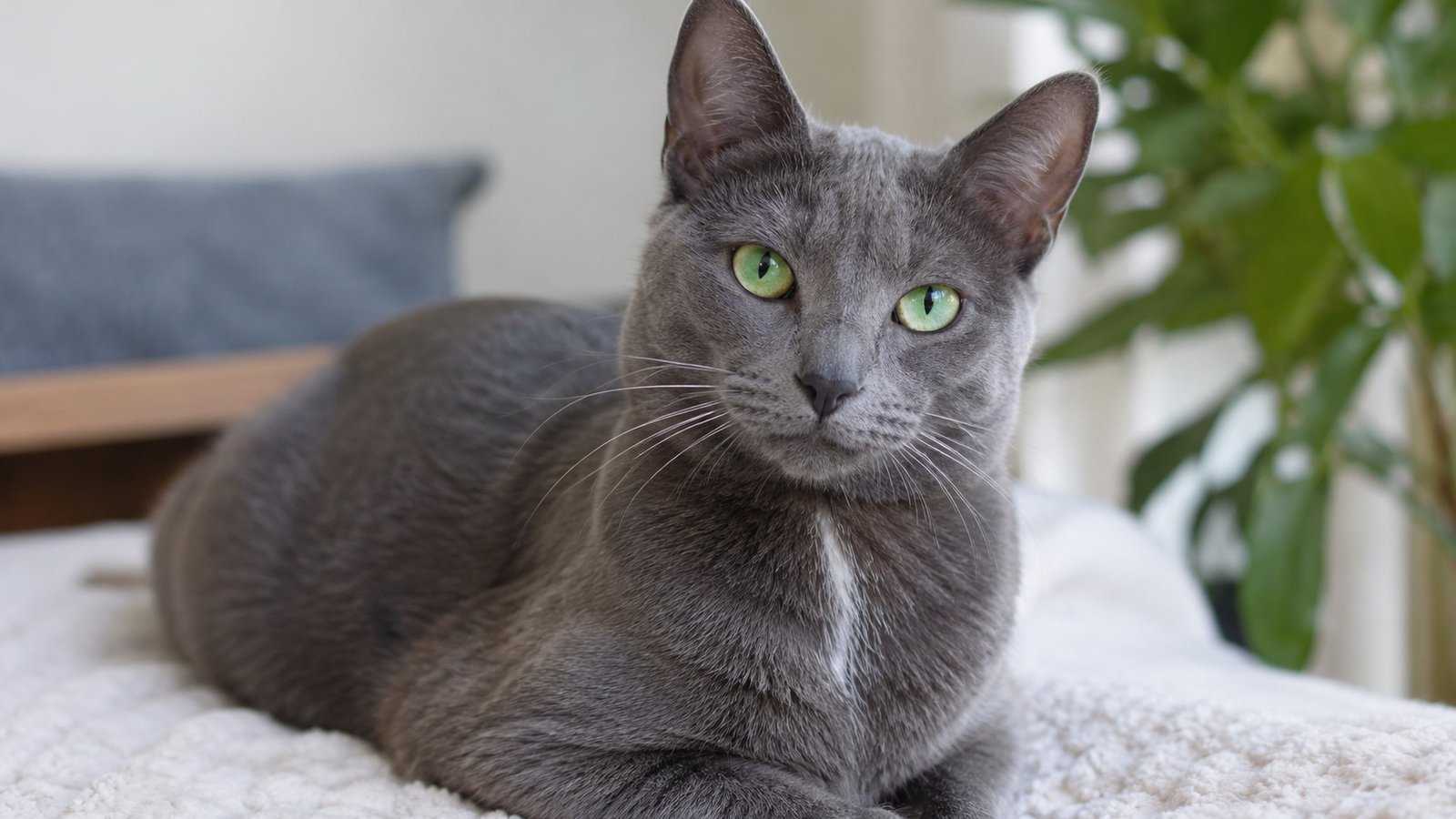
A Russian Blue cat female with a rare white line is an unusual sight that can make any cat lover curious. Russian Blue cats are famous for their elegant blue-gray coats, silvery sheen, and vivid green eyes, so even a tiny white stripe can stand out against their otherwise uniform appearance.
What causes this distinctive marking? Is it a natural genetic variation, a sign that your cat might not be a purebred Russian Blue, or something that deserves a closer look?
Understanding the possibilities can help you appreciate your cat’s unique appearance while making informed decisions about her care. This guide explores what a white line on a Russian Blue cat might mean, how coat genetics work, what breed standards say, and which changes to watch for to keep your feline companion healthy.
In This Article
Russian Blue Cat Female With a Rare White Line: What Makes Her So Special?
An unusual coat marking can make an already beautiful cat stand out, but understanding the marking is more useful than simply labeling it rare.
A female Russian Blue with a narrow white line has a distinctive appearance that differs from the classic look associated with the breed. The contrast between her blue-gray fur and a small area of white can make the marking particularly noticeable, especially when the light catches her coat.
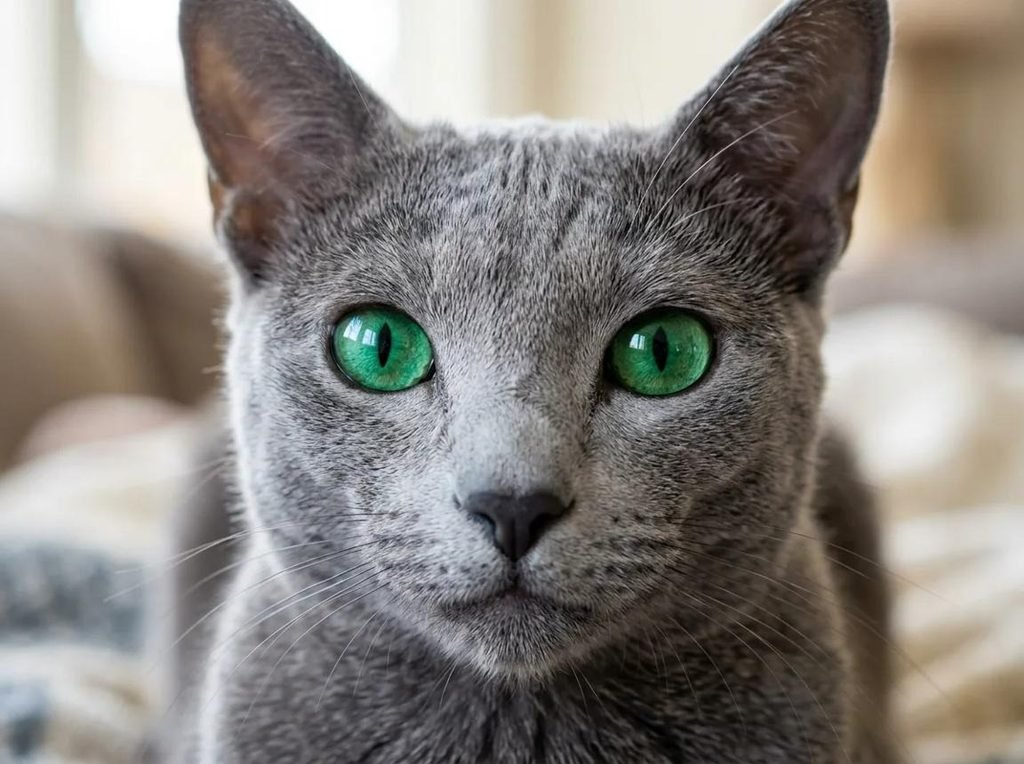
Russian Blues are known for their plush, double-layered coats and graceful body shape. Their individual hairs often have silver-colored tips, giving the fur a soft, shimmering effect. Their eyes typically develop into a vivid green as they mature.
A white line introduces a different kind of contrast. Depending on its location, it might resemble a thin stripe on the chest, a small mark on the face, or a narrow patch of lighter fur elsewhere on the body.
Why is this marking so unusual?
The traditional Russian Blue appearance calls for a solid, even blue coat, with silver tipping contributing to its characteristic sheen. Distinct white markings are generally not part of the conventional breed standard.
That does not mean a cat with a white line is automatically unhealthy or less lovable. It simply means her appearance differs from the expected standard.
Several possibilities could explain what you see:
- Inherited coat variation: Genetic differences can influence where pigment appears in a cat’s fur.
- A few white hairs: Small clusters of pale hairs can create the impression of a narrow stripe.
- Uncertain ancestry: A cat may resemble a Russian Blue without having a verified purebred pedigree.
- A change in the coat or skin: Newly appearing white hairs or changes accompanied by skin irritation may deserve veterinary attention.
These possibilities are not interchangeable, and appearance alone cannot determine which explanation applies to an individual cat.
Does being female make the white line more unusual?
Not necessarily. There is no established reason to assume that female Russian Blues are inherently more likely than males to develop white markings.
Most ordinary coat-color differences involve genetic factors that are not exclusive to one sex. Some feline color patterns are sex-linked, but a narrow white line should not automatically be attributed to the cat being female.
The most important point: A female Russian Blue with a white line may look unusual, but the marking alone does not establish her breed purity, genetic background, or health status.
What Does a Female Russian Blue With a White Line Actually Look Like?
A Russian Blue cat with a rare white line can look quite different depending on the marking’s location, size, and shape. Looking closely at these details helps you describe her appearance accurately and distinguish a stable coat marking from a change that might need attention.
The classic Russian Blue appearance
8
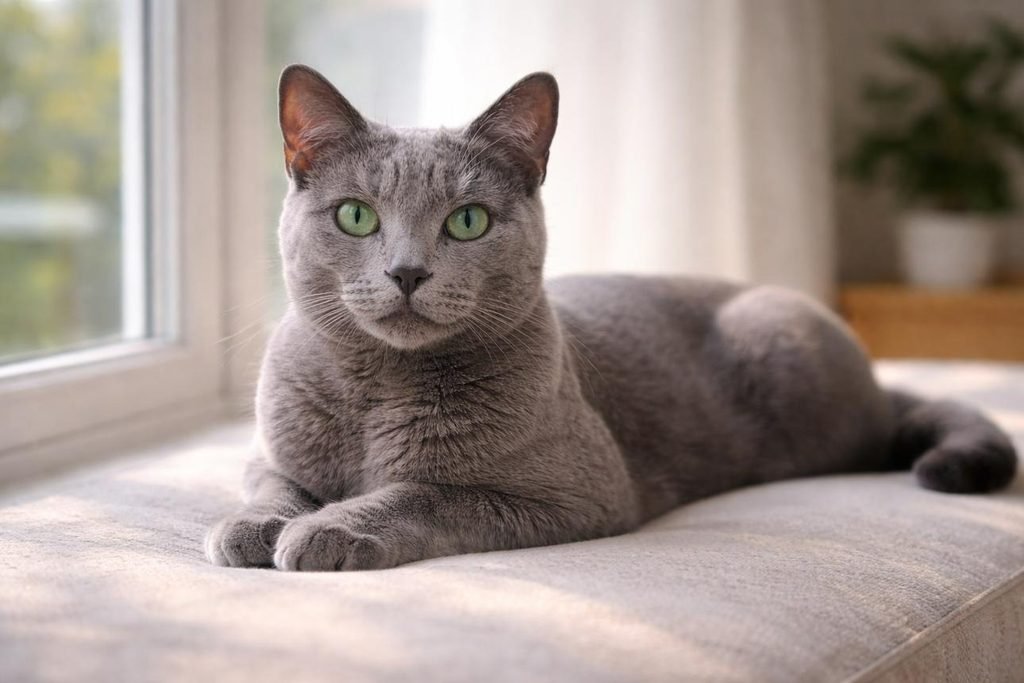
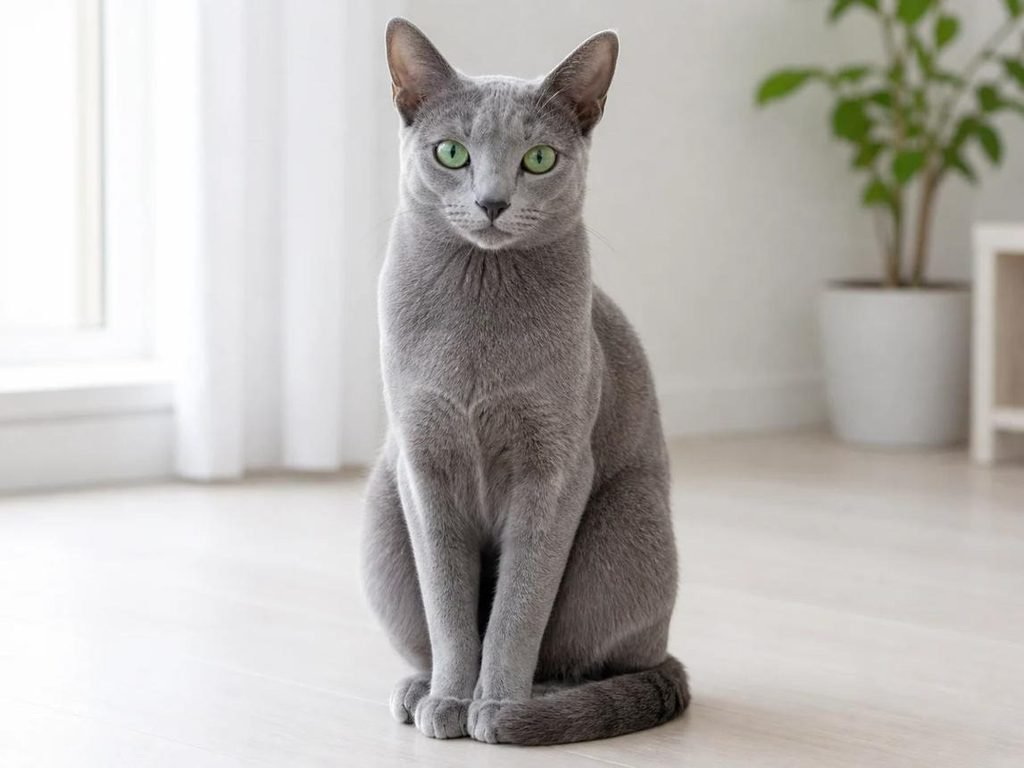
A typical Russian Blue has several recognizable physical features:
- Blue-gray fur: The coat appears blue rather than true gray, often with a soft silver sheen.
- Dense double coat: The short fur stands away from the body, giving it a plush texture.
- Green eyes: Mature cats typically have vivid green eyes, although kittens may have different eye colors while developing.
- Slender, graceful build: The body is generally elegant and muscular, with long legs and a balanced silhouette.
- Fine facial features: The face often has a gently wedge-shaped appearance, with prominent whisker pads.
These characteristics can help you recognize a cat that resembles the breed, but they cannot confirm pedigree on their own.
Where might a rare white line appear?
The position of the marking can change the way it looks.
| Location | What the marking might look like |
| Chest | A thin white stripe or small vertical mark below the chin |
| Belly | A narrow line visible when the cat stretches or rolls over |
| Face | A small white streak near the nose, forehead, or muzzle |
| Paw | A few white hairs or a narrow pale area around the toes |
| Side or back | A subtle line that becomes visible when the fur separates |
A genuine white marking consists of hairs with little or no pigment in that area. However, lighting and the natural silver tipping of Russian Blue fur can sometimes create a similar visual effect.
How can you tell a white line from the coat’s silver sheen?
Russian Blue fur naturally reflects light, which can make some areas appear lighter than others. A silvery highlight may shift or disappear when your cat changes position, while a true white marking generally remains visible in the same location.
Try taking photographs in natural daylight from several angles. Avoid using filters or editing the images, particularly if you are trying to document the marking for a breeder or veterinarian.
A useful tip: Photograph the marking when your cat is relaxed, and compare the pictures over several weeks if you are unsure whether its appearance is changing.
Is a White Line Normal on a Purebred Russian Blue Cat?
A white line is not typical of the traditional Russian Blue breed standard. However, the presence of a white marking does not, by itself, prove that a cat is mixed-breed or that her ancestry is incorrect.
Understanding the difference between a breed standard and an individual cat’s appearance can help you avoid drawing conclusions too quickly.
What does the Russian Blue breed standard say?
Russian Blue breed descriptions emphasize a uniform blue coat, often with silver-tipped guard hairs that create the breed’s characteristic shimmering appearance. The coat should generally look even rather than displaying distinct white patches.
White markings are usually considered a departure from the conventional standard. The exact implications depend on the rules of the particular cat registry and whether the cat is being evaluated for breeding or exhibition.
For pet owners, this distinction is important. A cat does not need to meet every show standard to be a wonderful companion.
Does a white line mean your cat is not purebred?
Not necessarily. A cat’s coat provides clues about appearance, but it cannot independently verify ancestry.
If you adopted your cat and do not have pedigree documentation, it is reasonable to describe her as a Russian Blue or Russian Blue-type cat based on her appearance, while recognizing that her ancestry may be uncertain.
If she came from a breeder and was sold as a pedigreed Russian Blue, consider asking for:
- Her pedigree or registration documentation.
- Information about the parents’ coat colors and markings.
- An explanation of whether the white line was present at birth.
- Guidance on the applicable breed registry’s standards.
A DNA test may provide information about genetic ancestry, depending on the test and its reference database, but it should not be treated as a definitive substitute for pedigree records.
Breed standards versus life as a pet
| Consideration | Why it matters |
| Breed standard | Describes the appearance expected for the breed |
| Pedigree | Documents ancestry through recognized records |
| Coat marking | Describes an individual physical characteristic |
| Health | Depends on the cat’s overall condition, not simply coat conformity |
| Pet suitability | Relates to temperament, health, socialization, and care |
Remember: An unusual white stripe is not a reason to reject, rehome, or love your cat any less. If she is comfortable, healthy, and well cared for, her individual appearance is simply one part of what makes her unique.
The Genetics Behind a Rare White Line on a Russian Blue
Cat coat color is determined by several interacting genetic factors. These influence the pigments produced in the hair, how those pigments are distributed, and whether particular areas of the coat develop without normal pigmentation.
A white line on a Russian Blue-type cat may reflect a difference in pigment distribution, but the exact cause cannot be established just by looking at the fur.
How does white spotting occur in cats?
White fur generally appears when hair grows without the usual pigment. One known mechanism involves genes associated with white spotting, including variation in the KIT gene, which plays a role in the development and distribution of pigment-producing cells.
Depending on the genetic combination involved, white areas can range from tiny spots to larger patches. The extent and location of white markings can vary considerably between individual cats.
However, not every small white mark should automatically be classified as genetic white spotting. A few isolated white hairs may have a different explanation, and a newly developing change may involve the skin or hair rather than a marking present from birth.
Why might a blue-gray cat have white hairs?
A cat’s overall coat color does not mean every hair must always contain the same amount of pigment. Differences in pigment production or distribution can result in individual hairs or small areas that look lighter than the surrounding fur.
Possible explanations include:
- Inherited variation affecting pigmentation.
- A small cluster of white hairs rather than a clearly defined patch.
- Natural differences in how the fur reflects light.
- Changes in hair pigmentation that develop over time.
These possibilities should be considered separately. A persistent white line that has been present since kittenhood may be approached differently from a patch that appeared suddenly in an adult cat.
Does a rare white line indicate a new Russian Blue variety?
No established conclusion about a new variety can be drawn from one cat’s unusual marking. A distinctive appearance does not automatically represent a recognized genetic mutation, a separate breed, or a newly accepted coat pattern.
Formal recognition requires much more than an unusual photograph or a single example. Genetic evidence, breeding records, and the relevant registry’s evaluation may all be important, depending on the claim being made.
Be cautious of online descriptions that label every unusually marked cat as a rare or exceptionally valuable Russian Blue. Such claims may be promotional rather than scientifically supported.
The practical takeaway: Genetics can help explain why white fur occurs, but identifying the precise cause in your cat may require pedigree information, a veterinary examination, or specialist assessment if other symptoms are present.
Four Possible Reasons Your Russian Blue Has a White Stripe
A narrow white stripe can have several explanations. The most helpful clues are when it appeared, whether the surrounding skin looks healthy, and whether the marking stays the same over time.
Inherited white spotting
A small white area may result from inherited differences in pigmentation. Such a marking might be visible from kittenhood and remain relatively stable as the cat grows.
The stripe could be sharply defined or irregular, depending on the distribution of unpigmented hairs.
Although inherited white spotting is one possibility, it should not be assumed to be the cause simply because the marking looks neat or symmetrical.
A few white hairs creating the illusion of a stripe
Sometimes, what appears to be a white line is actually a small group of pale hairs mixed into blue-gray fur.
This may become more noticeable when the coat is parted, when the cat stretches, or when light falls across the fur from a particular direction.
Check the area gently without pulling at the hairs. Photographing it under consistent lighting can help you determine whether the appearance changes with the angle or remains a clearly defined marking.
Coat development as your cat matures
Kittens can look different from adults as their coats develop. Hair length, texture, and the way light reflects from the fur may change with age.
A marking may therefore become easier to notice as the coat changes. However, a distinct white stripe should not automatically be dismissed as a normal age-related change, particularly if it appears suddenly in a mature cat.
If you cannot remember the marking being present before, take a photograph and monitor it rather than assuming it is harmless.
Changes involving the skin or fur
A new pale area may sometimes accompany a skin or hair condition. For example, inflammation, hair loss, skin injury, or changes in pigmentation can affect how a patch of fur looks.
Pay attention to additional signs such as:
- Redness, swelling, or flaky skin.
- Bald patches or broken hairs.
- Persistent scratching, licking, or rubbing.
- Sores, scabs, or visible discomfort.
- A marking that expands or changes noticeably.
These symptoms do not necessarily indicate a serious illness, but they can help your veterinarian determine whether an examination is needed.
If the white area is new and accompanied by skin changes, arrange a veterinary appointment. Seek prompt care if your cat has significant pain, rapidly worsening lesions, or other signs of illness.
Never use bleach, hair dye, or human skin treatments to change or investigate the marking. These products may irritate your cat’s skin, and some substances can be toxic if licked during grooming.
How to Tell Whether the White Line Is a Natural Marking or a Health Concern
A white line on your Russian Blue cat is not automatically a reason to worry. The most important clues are whether the marking has always been there, whether it is changing, and whether the surrounding skin looks healthy.
A stable patch of white fur with normal skin is generally less concerning than a new patch accompanied by redness, hair loss, or persistent itching. Even so, appearance alone cannot confirm the cause.
Signs that may be reassuring
The marking may be a harmless coat variation if:
- It has been present since your cat was a kitten or was first adopted.
- Its shape and size remain relatively consistent.
- The skin underneath looks normal.
- Your cat does not scratch, lick, or rub the area excessively.
- Her appetite, energy, grooming habits, and behavior remain normal.
These observations can help you describe the situation to your veterinarian if you have questions.
Warning signs you should not ignore
Pay closer attention if the white line appears suddenly or develops alongside other changes.
| What you notice | What to do |
| A new white patch without other symptoms | Photograph it and arrange veterinary advice if it persists or changes |
| Redness, scaling, or persistent itching | Schedule a veterinary examination |
| Bald patches or broken hairs | Have your cat examined to investigate possible skin or coat problems |
| Sores, swelling, or noticeable pain | Seek prompt veterinary care |
| Rapidly spreading skin changes or worsening lesions | Contact your veterinarian promptly |
| Significant lethargy, poor appetite, or other signs of illness | Seek veterinary advice promptly, especially if symptoms are severe |
A white line alone does not establish a diagnosis. Conditions affecting the skin, hair follicles, or pigmentation can look different from one another, so it is best not to treat the marking without knowing what is causing it.
How to monitor the marking at home
You do not need to inspect your cat constantly. A simple routine is usually enough.
- Take a clear photograph in natural light.
- Note the location, approximate size, and date.
- Check the surrounding skin during normal grooming.
- Compare photographs periodically to see whether the marking changes.
- Contact your veterinarian if you notice new symptoms or cannot explain a significant change.
Avoid repeatedly rubbing the white line or pulling apart the fur, as this may irritate the area and make it harder to assess.
For additional guidance on feline skin problems, visit the Cornell Feline Health Center, which provides educational resources on cat health and common medical concerns.
Can a Russian Blue With a Rare White Line Still Be a Wonderful Pet?
Absolutely. A female Russian Blue with a rare white line can be just as affectionate, playful, and rewarding a companion as a cat whose coat perfectly matches the traditional breed description.
The marking describes her appearance, not her personality or her value as a pet. What matters most is her health, temperament, environment, and the quality of care she receives.
Understanding the Russian Blue personality
Russian Blues are often described as observant, intelligent, and somewhat reserved around unfamiliar people. Many form strong bonds with their familiar caregivers and enjoy spending time nearby without necessarily demanding constant attention.
Individual cats vary, however. Some are outgoing and playful, while others prefer a quieter environment and a slower introduction to new people.
A white stripe does not indicate a particular personality trait. Your cat’s behavior will depend on her individual temperament, experiences, socialization, and surroundings.
Helping your cat feel comfortable at home
A comfortable home environment can help your Russian Blue feel secure and confident.
Consider providing:
- A quiet resting area: Give her a comfortable place where she can sleep without frequent interruptions.
- Daily interactive play: Wand toys and supervised chasing games help provide mental stimulation and exercise.
- Safe elevated spaces: Cat trees, shelves designed for pets, and window perches offer opportunities to climb and observe.
- Consistent routines: Predictable feeding and play schedules can help reduce stress.
- Positive social interaction: Let her approach unfamiliar people at her own pace rather than forcing contact.
If your cat is shy, allow her to retreat when she wants privacy. Respecting her boundaries can help build trust over time.
Does the white line affect her health or breeding suitability?
A white marking alone does not establish that your cat has a health problem. It also does not determine whether she is suitable for breeding.
If you are considering breeding a pedigreed Russian Blue, consult a qualified veterinarian and the relevant breed registry. Coat standards, pedigree requirements, genetic considerations, and overall health should all be evaluated rather than relying on appearance alone.
For a companion cat, the priority is straightforward: maintain good health, provide enrichment, and enjoy her individual characteristics.
White Line vs. Other White Markings: How to Describe Your Cat Accurately
Not every pale area on a blue-gray cat represents the same type of marking. Describing what you see accurately can help when speaking with a breeder, shelter, veterinarian, or cat registry.
Common types of white markings
| Appearance | Description |
| Thin white line | A narrow, elongated area of white hairs |
| White chest spot | A small, localized patch on the chest |
| White facial blaze | A white marking running along part of the face |
| White toes | White fur limited to one or more paws |
| Scattered white hairs | Individual pale hairs mixed with the surrounding coat |
| Silver-tipped fur | Pale tips that create a silvery sheen without necessarily forming a true white patch |
The distinction between silver-tipped fur and a true white marking is particularly relevant to Russian Blue cats. Their natural coat can reflect light in a way that makes some areas look lighter than others.
How to document the marking
If you want to understand your cat’s coat pattern more clearly, create a simple photo record.
- Take one photograph showing her entire body.
- Capture a closer image of the white line.
- Use natural, indirect daylight when possible.
- Photograph the area from more than one angle.
- Record whether the marking was present when she was a kitten or appeared later.
Avoid relying on heavily edited photographs when discussing breed characteristics. Filters can change the apparent color of the fur and make a subtle silver highlight look like a white marking.
If you have pedigree documents, keep them alongside your photographs. The documents may help establish ancestry, while the photographs show the specific appearance of your cat.
Accurate documentation is more useful than labeling a marking as rare without supporting evidence. It gives professionals a clearer picture of what you are seeing and whether anything needs further investigation.
Caring for a Russian Blue’s Distinctive Coat
Russian Blues are known for their dense, plush double coats. Although their fur generally does not require complicated grooming, regular care helps keep it in good condition and gives you an opportunity to notice changes in the skin.
A white line does not require a special grooming routine. The goal is to maintain a healthy coat without irritating the marked area.
Establish a simple brushing routine
Brush your cat gently about once or twice a week, adjusting the frequency according to how much loose fur she sheds and how well she tolerates grooming.
A soft cat brush or an appropriate grooming tool can help remove loose hairs without excessive pulling.
Follow these steps:
- Choose a quiet time when your cat is relaxed.
- Begin with gentle strokes along the back and sides.
- Work carefully around sensitive areas, including the belly and legs.
- Check the skin for redness, scabs, unusual hair loss, or other changes.
- Stop if your cat becomes uncomfortable or tries to move away.
Short, positive grooming sessions are often more successful than trying to brush the entire coat at once.
Should you bathe a Russian Blue to clean the white line?
Usually, no. Healthy cats generally keep themselves clean, and a small white marking does not need to be washed away.
Frequent bathing may dry or irritate the skin, particularly when unnecessary shampoos are used. If your cat genuinely needs a bath, choose a product specifically formulated for cats and follow appropriate veterinary advice.
Never use human hair products, whitening shampoos intended for other animals, bleach, or dyes to alter the appearance of the stripe.
Grooming mistakes to avoid
- Brushing aggressively in an attempt to remove white hairs.
- Scrubbing the marked area repeatedly.
- Shaving the coat for cosmetic reasons.
- Using products that claim to change fur pigmentation without veterinary guidance.
- Ignoring redness or hair loss because you assume it is related to the marking.
Regular grooming should help your cat feel comfortable, not make her coat conform to a particular appearance.
Nutrition and Everyday Care for a Healthy Russian Blue
A healthy coat begins with good overall care. Although nutrition supports normal skin and hair growth, there is no reason to assume that a white line is caused by poor nutrition or that supplements will remove it.
Your Russian Blue needs a balanced diet, fresh water, regular activity, and preventive veterinary care regardless of her coat pattern.
Choose a complete and balanced cat food
Select food formulated for your cat’s life stage, whether she is a kitten, adult, or senior. Her activity level, body condition, and individual medical needs should also influence feeding decisions.
Look for a diet labeled as complete and balanced for the appropriate life stage under the nutritional standards applicable in your country.
Protein, essential fatty acids, vitamins, and minerals all contribute to normal body function and coat maintenance. However, adding extra supplements is not automatically beneficial when a cat already eats an appropriate diet.
Do not give high-dose vitamins, minerals, or skin supplements solely to change the white marking. Ask your veterinarian before introducing supplements, especially if your cat has an existing medical condition.
Support hydration and healthy activity
Make fresh water available throughout the day. Some cats prefer wide bowls, while others drink more readily from a pet fountain. Observe your cat’s preferences and keep water containers clean.
Daily play also helps maintain a healthy weight and provides mental stimulation. Interactive toys, food puzzles designed for cats, and safe climbing areas can all contribute to an enriching routine.
Keep up with preventive veterinary care
Regular checkups allow your veterinarian to assess your cat’s weight, teeth, skin, coat, and general health.
Your cat may also need routine parasite prevention, vaccinations, and dental care based on her age, lifestyle, and local veterinary recommendations.
If the white line changes, mention it during the appointment. A photograph showing how it looked previously can be particularly useful.
Common Myths About Russian Blue Cats With White Markings
Unusual coat markings often attract confident claims online. Some are based on misunderstandings about genetics, while others confuse breed standards with health or ancestry.
Here are several common myths worth correcting.
Myth: Every purebred Russian Blue must look exactly the same
Fact: Breed standards describe the expected characteristics of a breed, but individual cats can differ in appearance. A distinct white marking is generally outside the traditional Russian Blue standard, yet appearance alone cannot prove a cat’s ancestry.
Myth: A white line automatically means the cat is mixed-breed
Fact: A white marking may prompt questions about pedigree, but it cannot establish ancestry by itself. Registration records and reliable breeding documentation are more useful when verifying whether a cat is pedigreed.
Myth: A white stripe always signals a medical problem
Fact: A longstanding marking with normal-looking skin and no other symptoms may simply be a coat variation. New or changing markings, particularly those accompanied by skin irritation or hair loss, deserve closer attention.
Myth: A rare white line makes a Russian Blue a new breed variety
Fact: An unusual appearance does not automatically qualify as a recognized variety. Formal recognition depends on the relevant registry’s rules and supporting evidence, not merely on a distinctive coat.
Myth: The white line should be removed or hidden
Fact: A harmless marking does not need cosmetic treatment. Attempting to dye, bleach, or otherwise alter your cat’s fur can cause unnecessary irritation or expose her to harmful substances.
The best approach is to understand what you are seeing, avoid unsupported claims, and prioritize your cat’s well-being over appearance.
Frequently Asked Questions About Female Russian Blue Cats With Rare White Lines
Can a female Russian Blue cat naturally have a white line?
Yes, an individual cat that resembles a Russian Blue may have a small white marking or a few white hairs. Distinct white markings are not typical of the traditional breed standard, and the exact cause cannot be determined from appearance alone.
Are female Russian Blue cats more likely to have white markings than males?
There is no established evidence that female Russian Blues are inherently more likely to develop a white line than males. The presence of white fur should not automatically be attributed to the cat’s sex.
Does a white stripe mean my Russian Blue is mixed-breed?
Not necessarily. The marking differs from the conventional breed standard, but it cannot independently establish ancestry. Pedigree documentation is more useful for verifying whether a cat is registered as a purebred Russian Blue.
Will the white line disappear as my cat grows older?
It depends on the cause. A persistent white marking may remain, while changes in coat development or the way fur reflects light can affect its appearance. A newly developing or changing patch should not automatically be assumed to be a normal age-related change.
Can a Russian Blue with a rare white line be registered or entered in cat shows?
Registration and show eligibility depend on the relevant registry’s requirements, pedigree documentation, and breed standard. Contact the registry or a knowledgeable breeder for guidance specific to your cat.
Should I take my cat to the vet because of a white line?
A stable white marking with healthy-looking skin and no other symptoms may not require an urgent visit. However, seek veterinary advice if it appears suddenly, expands, or occurs alongside redness, itching, sores, hair loss, or other changes.
Can food or supplements remove a white line from a Russian Blue’s coat?
There is no good reason to expect ordinary dietary supplements to remove an inherited white marking. Feed a complete and balanced diet, and consult your veterinarian if you suspect a nutritional problem or notice changes in your cat’s coat.
How can I tell whether the white line is real or just the silver sheen of Russian Blue fur?
Observe the area in natural light and from several angles. A true white marking generally remains in the same location, whereas a reflection or silver highlight may change with the lighting and position of the fur.
Give Your Russian Blue the Care That Makes Her Shine
A Russian Blue cat female with a rare white line is a reminder that individual cats do not always match the appearance we expect from a breed description. Her distinctive marking may reflect a difference in pigmentation, a few white hairs, or another feature of her coat, but it does not automatically indicate a health problem or prove anything about her ancestry.
Take time to observe the marking, maintain a gentle grooming routine, provide balanced nutrition, and arrange veterinary care when changes or concerning symptoms appear. If pedigree matters to you, rely on reliable documentation rather than appearance alone.
Most importantly, appreciate your cat for more than her coat. Her health, comfort, personality, and bond with you matter far more than whether every hair matches the traditional Russian Blue standard.
If you enjoyed learning about this unusual feline feature, explore more of our cat-care guides on grooming, nutrition, and feline skin health to help your companion stay happy, comfortable, and well cared for.

Passionate about pets and animal care, we shares trusted tips, fun facts, and practical advice to help pet lovers give their furry, feathered, and scaly companions the best life possible. From everyday care guides to fascinating animal insights, we’re dedicated to making pet information easy, helpful, and enjoyable for every reader.